Friday, May 11, 2012

Portrait of a Future Wife


The William Matthew Prior portraits are coming in and we are laying them out in the gallery. This is one of my favorite parts of the job, seeing artwork come together and shaping multiple pieces into a coherent exhibition. The exhibition is shaping up nicely, but the most fascinating thing has been the inscriptions on the reverse of many of the canvases. I thought I would share a few of those with you.

Here is Prior's portrait of his future wife, Rosamond. He met her when he went from his hometown of Bath, Maine, to Portland to seek training in the painting trade. After arriving in town, he went to the best known house painter in the area, Avery Hamblin. As luck would have it, Avery had a daughter. Here she is. Prior painted her in 1824 and married her in 1828.


The inscription reads: "W. M. Prior, Painter, formerly of Bath, 1824, 3 piece on cloth, painted in C. Codman's shop, Portland, Maine." Codman was a marine painter that Prior trained with in his early years.

In making such a detailed inscription Prior was documenting himself in preparation for an artistic career. What we may never know is what personal thoughts he may have had in mind while painting Rosamond. He may have been showing off a bit for her by adding so much detail. It does seem that he made the right first stop when arriving in Portland, and certainly had a flair for impressing his patrons.

Thursday, April 5, 2012

An Early American Portrait on Glass


Most early American folk portraitists worked in either oil on canvas or watercolor on paper. Very few mastered the art of reverse painting on glass. This was an art form that was hundreds of years old in Europe, but was actually brought to the United States in great numbers from China during the years of the China Trade from the mid-1700s to the mid-1800s. Reverse painting on glass wasn't even taught in America until the late 1780s, in Philadelphia. Somehow, our limner Benjamin Greenleaf of Hull, Massachusetts, learned the art form by the time he painted this reverse glass portrait of Lydia Waterman of Hingham, Massachusetts in 1810.


Reverse painting on glass has a luminous effect that is very enjoyable to behold. The brush strokes are so smooth against the surface and the play of light as it reflects on and through the glass brings out the color in ways that canvas or paper cannot. The really fascinating thing about this art form is that the artist had to do the painting in reverse, painting the highlights first and the base coats last; just the opposite of how most artists learn to paint.

Not much is know about Greenleaf. He was born in Hull in 1769, married in 1799, and died in 1821. He lived in Dorchester and painted portraits in Eastern Massachusetts, New Hampshire, and Maine. There are a few dozen of his works known, most of which are on glass as this one is. I've always been partial to our portrait of the 74-year-old Lydia Waterman in her white bonnet with her matter-of-fact expression. That the artist was able to capture her personality so well in such a demanding medium makes this a real masterpiece, and the fact of its fragility makes it a remarkable survival as well.

Wednesday, March 28, 2012

William Matthew Prior Revealed


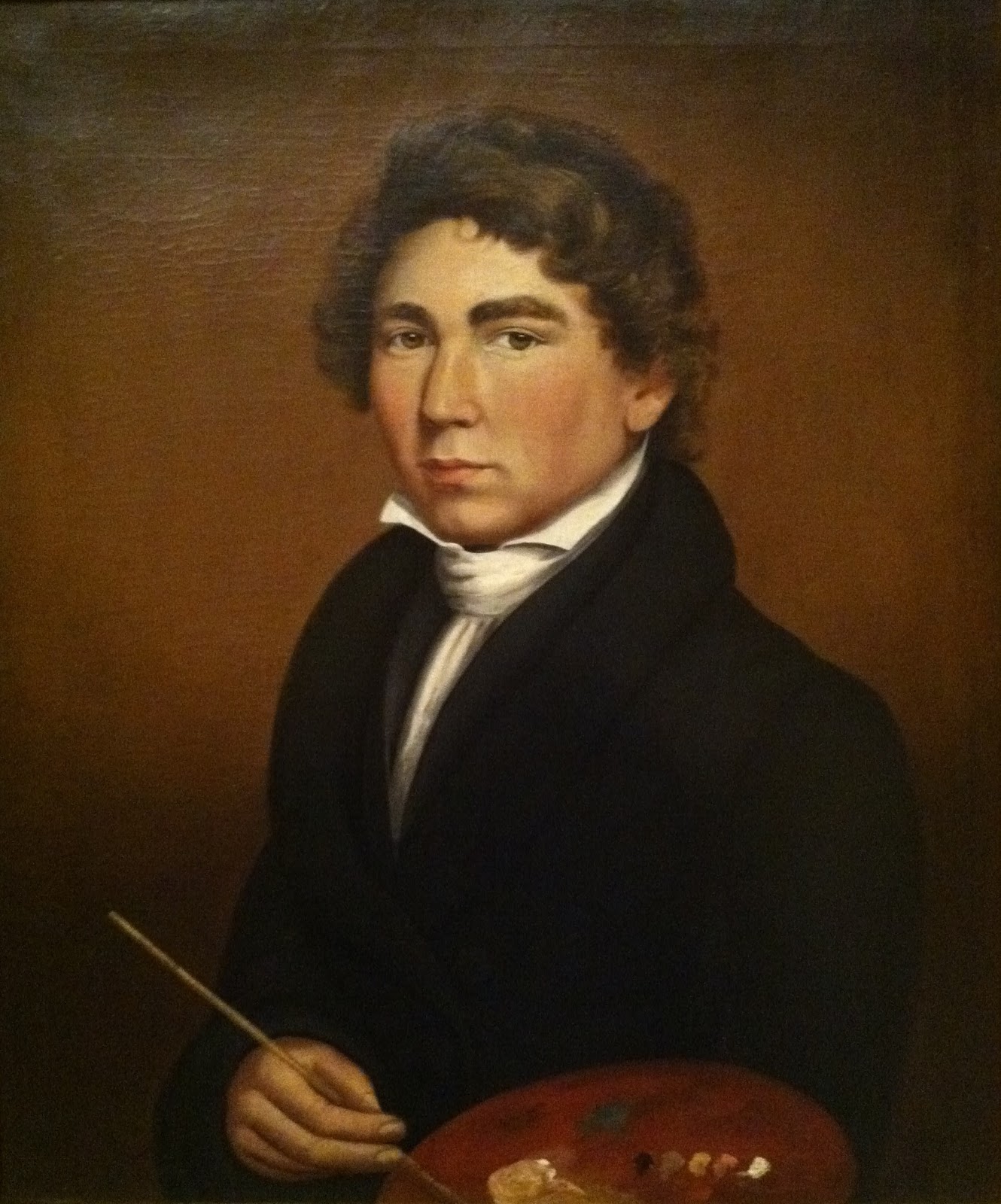
We recently had our great self-portrait by William Matthew Prior conserved in preparation for the upcoming exhibition, Artist & Visionary: William Matthew Prior Revealed, which opens May 26 at the Fenimore Art Museum. I must admit that even though I expected it to look better than before, the results far surpassed my expectations. Judge for yourself by comparing the piece after conservation (above) and before (below). The conservators at West Lake Conservators did a fantastic job.


In particular, please note the colors on the artist's palette, now visible in their full richness. It is no accident that Prior tilted the palette outward so we could have this view of the color scheme that enlivened so many likenesses of his in the early 19th century. As our guest curator, Jackie Oak, stated, "For Prior, art was a business." That is why this self-portrait not only shows who he was, but also gives the prospective client a taste of the range of hues at his disposal to use in immortalizing his subjects.

Thursday, March 15, 2012

Got Wheat?


One large, central, sheaf of wheat. This image welcomed patrons to Lansings’ Inn, an establishment in Lansingburgh, New York, in the opening years of the nineteenth century. Located on the Hudson River about 12 miles north of Albany, Lansingburgh was a busy place at the turn of the century. Today incorporated into the city of Troy, Lansingburgh then boasted its own academy, shipyards, newspaper, and upwards of 10 taverns! With so much competition and bustle in Lansingburgh, why did the owner of Lansing’s Inn choose a wheat sheaf, of all things, to grace the all-important sign?


There are a few different reasons why this could be the case. The unknown owner and the anonymous maker of the sign obviously thought carefully about what image they wanted to depict. Wheat was an important commodity in the area during the early nineteenth century. Local farmers would bring their wheat into town, where it would be sold and shipped on the Hudson River. Troy’s city seal also evidences the economic importance of wheat-it is a sheaf of wheat surrounded by boxes and barrels with a tall merchant ship in the background. The wheat market played a significant role in the region’s development and success.


Since wheat was so important to the area economy, it would have been a recognizable image to people in town. It could have meant a variety of different things to them, from a literal reading as an agricultural crop or a trade good to a symbol of national prosperity or a desire for a good harvest. It also reflected well on Lansing’s Inn, announcing the establishment as a prosperous place, with plenty of good food and drink.  Paradoxically, the sheaf of wheat was both a very local but also a very universal symbol.

As an advertisement, the sign would have appealed to many different audiences, welcoming all to the inn. Locals or travelers, farmers or merchants, one large, central sheaf of wheat spoke to them all.

Got Wheat?

by Ashley Jahrling, American Folk Art course, Cooperstown Graduate Program
Blog Widget by LinkWithin