Showing posts with label Weathervanes. Show all posts

Saturday, August 4, 2012

A Complex Peace


After nine long years, George Washington had had enough of war. Returning to his beloved home, Mount Vernon, he directed his architect, Joseph Rakestraw, to create a weathervane crowned by a Dove of Peace to adorn the cupola. His instructions were specific: "I should like to have a bird (in place of the Vain) with an olive branch in its Mouth..."


While the message of the weathervane was clear, it says a lot about Washington’s practical nature and his obsession with the weather that it had to be fully functional. Accordingly, he was adamant that it be installed carefully and correctly. Writing from Philadelphia at the time the Dove of Peace was delivered to Mount Vernon, he stated: "Great pains...must be taken to fix the points truly; otherwise they will deceive rather than direct-(if they vary from the North, South, East, and West)-one way of doing this may be by my Compass being placed in a direct North line on the ground at some distance from the House."

A recent trip to Mount Vernon underscored the importance of the weathervane to the estate. It is the one object that can be seen from everywhere, and its high perch is a constant reminder of its owner’s high hopes that he and the new nation would enjoy extended peace and prosperity. The Dove of Peace  atop the cupola seen by visitors to Mount Vernon is now, of course, a replica of the original, although the other elements of the weathervane structure, including the mast, ball, and directional, are all in the same prominent location they were so carefully placed at Washington’s direction in 1787.

The Dove can still be seen, although it has been moved to an indoor gallery in the Donald W. Reynolds Museum and Education Center as part of the “At Home with the Washingtons” exhibition. It is quite startling to see the Dove up close and at eye level, but it is still a stunning example of early American metalwork. It is also in fine shape, having undergone its most recent restoration in 2008. Photographs are not allowed in the gallery, but I did find this one image from a visitor’s web album.


It is an interesting aside that the Dove’s first documented restoration coincided with another era in which the longing to Peace prevailed: 1946, in the wake of the Second World War. As an masterfully executed folk image representing a precious ideal, the Dove remains (admittedly, along with the newly restored slave quarters) one of the things that stays on your mind long after leaving Mount Vernon. As always, history is best defined by its contradictions.

Wednesday, October 5, 2011

Flying Fame


Fame is fleeting. This magnificent weathervane from the Jane Katcher Collection of Americana (made about 1890 and measuring 30" x 31")  gets that message across in the plainest terms possible. 


The Greek Goddess and allegorical figure of Fame, trumpeting a triumph and bestowing a laurel wreath, was actually a rare subject for commercial weathervane manufacturers of the late nineteenth century. The delicate figure was undoubtedly difficult to execute and has only a limited number of appropriate placements. It simply wouldn't work on a cow barn. 


This weathervane is one of the only four known examples featuring Fame, and – despite the fact that Fame is a winged figure – the only ope depicted in a flying pose. Its maker is unknown, although the weathervane was probably the product of a major shop such as E.G. Washburne & Co., J.L. Mott Iron Works, and J.W. Fiske, all of New York. Attribution of these weathervanes is made difficult by the standard practice of borrowing designs or buying and reusing parts. 


This weathervane is said to have been found on a building possibly used as a preparatory school for girls by a Catholic diocese in the Boston area. Since learning this fact I've been trying to imagine what the Nuns would say to the girls in relation to the weathervane. Was it aspirational? Or a warning about the pursuit of fame? Did the weathervane predate the school altogether?


Regardless of its original context, this weathervane is a killer piece, and its your to enjoy in our galleries for the rest of the year.


Monday, January 3, 2011

Weathervanes: More Tools of the Trade


I've done quite a few posts about weathervanes, and have even shown a great carved weathervane pattern of a bull that gives some insight into how these iconic piece of folk art were made. Recently, while browsing through our collections facility, I came across two other objects that add more to the story.


Many weathervanes began with a hand carving, like the bull. From this carving the maker would create a plaster or ceramic mold, which would in turn be used to make a castiron figure resembling the original carving. Copper sheets would be hammered over the iron and soldered together to make the final, hollow-bodied and lightweight weathervane. Weathervane manufacturers held onto their molds as long as they were producing the vanes, but all too often these pieces of their history would be discarded when the company went out of business. Most weathervane manufactories did not survive the great Depression of the 1930s, and so the tools of the trade are rare.


We are lucky to have the carved bull, of course, but the other pieces I found represent the second step in the process. These are two sides of a ceramic mold for a small cow weathervane, sold to the Fenimore Art Museum in 1956 by Adele Earnest and Cordelia Hamilton of the Stony Point Antiques Gallery in Stony Point New York. Earnest and Hamilton also sold us the bull, showing how adept they were at finding the exceptional pieces of folk art that were still floating around in estates and shops at that time.

We don't know where these molds came from, unfortunately, but they are remarkable survivals nonetheless. They are about 17" wide and 10" tall, and one of them is marked "14 COW," which indicates the number and subject of the pattern that this company offered. I would guess that they date to the late 19th century.


Finding these pieces was another reminder that a really good weathervane exhibition, including contextual material like these, would be an eye-opener for many people. That is something that is increasingly on my radar screen for the coming years.

Sunday, December 26, 2010

James Lombard: Maine Weathervanes


Not all late 19th-century weathervanes are extravagant, mass-produced ornaments for prosperous farmsteads. Although the norm at the time was for these elaborate vanes to be produced and marketed by large firms in Boston or New York, there is one humble maker who has become a famous counterpart to our understanding of this art form.

He is James Lombard, a farmer from central Maine who was born in 1865 and at some point in his young life produced weathervanes for his community of Bridgton and as far away as Wells, Maine. Lombard worked with simple planks of pine, which he sawed and chiseled into fantastic shapes for his vanes. We have three in the Fenimore Art Museum collection, each about eighteen inches tall, and they all show Lombard’s talent in creating the lively silhouettes of the chickens that were the subjects of the pieces. Look how he made the cutout areas form their own designs, and how proudly these birds show off their plumage.


We’re very lucky to have the Lombard vanes we have. The one painted white (just above) was found on a hen house in Wells, Maine, fully sixty miles to the south of Lombard’s home in Bridgton. This distance may indicate that he traveled to peddle these vanes in his youth.

The weathervane at the top of this post, however, is really special. You can tell that it was made with more care than the other one, and is a more successful composition. It’s coat of white paint is much older, suggesting that it was treasured as a relic rather than “restored.” Where was this one found? The barn of the Lombard Homestead itself in Bridgton. This was the vane that Lombard himself saw every day as he worked his farm until he passed away in 1920. 

Saturday, December 4, 2010

The Knickerbocker Mystery


The landlord of the Columbian Hotel in New York, a Mr. Seth Handaside, made a startling announcement one day in 1809. One of his tenants had disappeared and left behind a large debt of unpaid rent. But that was not all he left behind. In the abandoned room, Handaside found a manuscript entitled:


A history of New York, from the beginning of the world to the end of the Dutch dynasty, Containing among many surprising and curious matters, the unutterable ponderings of Walter the Doubter, the diasastrous projects of William the Testy, and the chivalric achievments (sic) of Peter the Headstrong, the three Dutch governors of New Amsterdam; being the only authentic history of the times that ever hath been, or ever will be published.


The manuscript was signed by a Diedrich Knickerbocker, the tenant who ran off to parts unknown. The landlord, in an attempt to recoup his losses, handed the manuscript over to a printer, who published it that same year. The book and its mysterious author were the talk of the town for months. A History of New York was a rollicking tale of the colorful personalities and foibles of the old Dutch families that still dominated New York society. Knickerbocker had produced a big literary hit.


Only, as you probably know, there was no Diedrich Knickerbocker. When word got out that the tenant story was a ruse, and the real author was a little known and unsuccessful lawyer, people were shocked. As the author was not of Dutch descent, his book took the older families aback for poking fun at their ancestors. But the young writer went on to achieve lasting fame, and his creation, Diedrich "Father" Knickerbocker, went on to become a character that represented New York much the way uncle Sam represents the United States.


I'm speaking, of course, about Washington Irving. His creation, Father Knickerbocker, was seen everywhere in the 19th century, in cartoons and editorials, magazines and advertisements. Even a weathervane that has a long history right here in James Fenimore Cooper country. 


We have a large weathervane of him, and it is one of the best in The Farmers' Museum collection. Everything about it -- the detail of the scowling face, the plump body overwhelming the poor, small chair, the tall hat, the pint he is drinking, and especially the surface patina (and bullet holes!) -- speaks to its quality as an artwork and artifact. But there is something even better.


I've said on previous occasions here how rare it is for a 19th-century weathervane to have any history, let alone a photograph of it in its original location. Our angel weathervane from Nantucket is one example. The great thing about Father Knickerbocker is that we have photos of him sitting atop the barn of Edward Severin Clark's Fenimore Farm, the property that became The Farmers' Museum (the sister institution to the Fenimore Art Museum) in the 1940s. The pictures are probably from the later 19th century, prior to the construction of the massive stone barn that is the main entrance to the Museum today. 


It's great to have such a magnificent part of our history in our collection, especially one that is tied to such a long tradition of history and literature in New York State. But even though it is common for weathervanes to have bullet holes in them, I can't for the life of me imagine what kind of person would shoot at our Father Knickerbocker. A Cooper fan perhaps?

Monday, November 1, 2010

Angels and Roosters


On my recent visit to Minneapolis to attend the opening of our own Eugene and Clare Thaw Collection of American Indian Art at the Minneapolis Institute of Arts, I had the pleasure of spending several hours in the Institute enjoying their many galleries of artworks from around the world. As you read in my last post, the folk art of Japan was a pleasant surprise, but I also encountered an unexpected treasure trove of American folk art.

The MIA is Byzantine; not in its organization but in the layout of its galleries. i loved wandering through the many nooks and crannies of the place, turning corners and finding things that were not mentioned on the visitor guide. As I walked down one long corridor, looking for the cafe, I came across a multi-story atrium (above) that yielded a pleasant and familiar sight. On the top floor, just above the mezzanine level with the cafe, was a hallway gallery of 19th-century American weathervanes. 

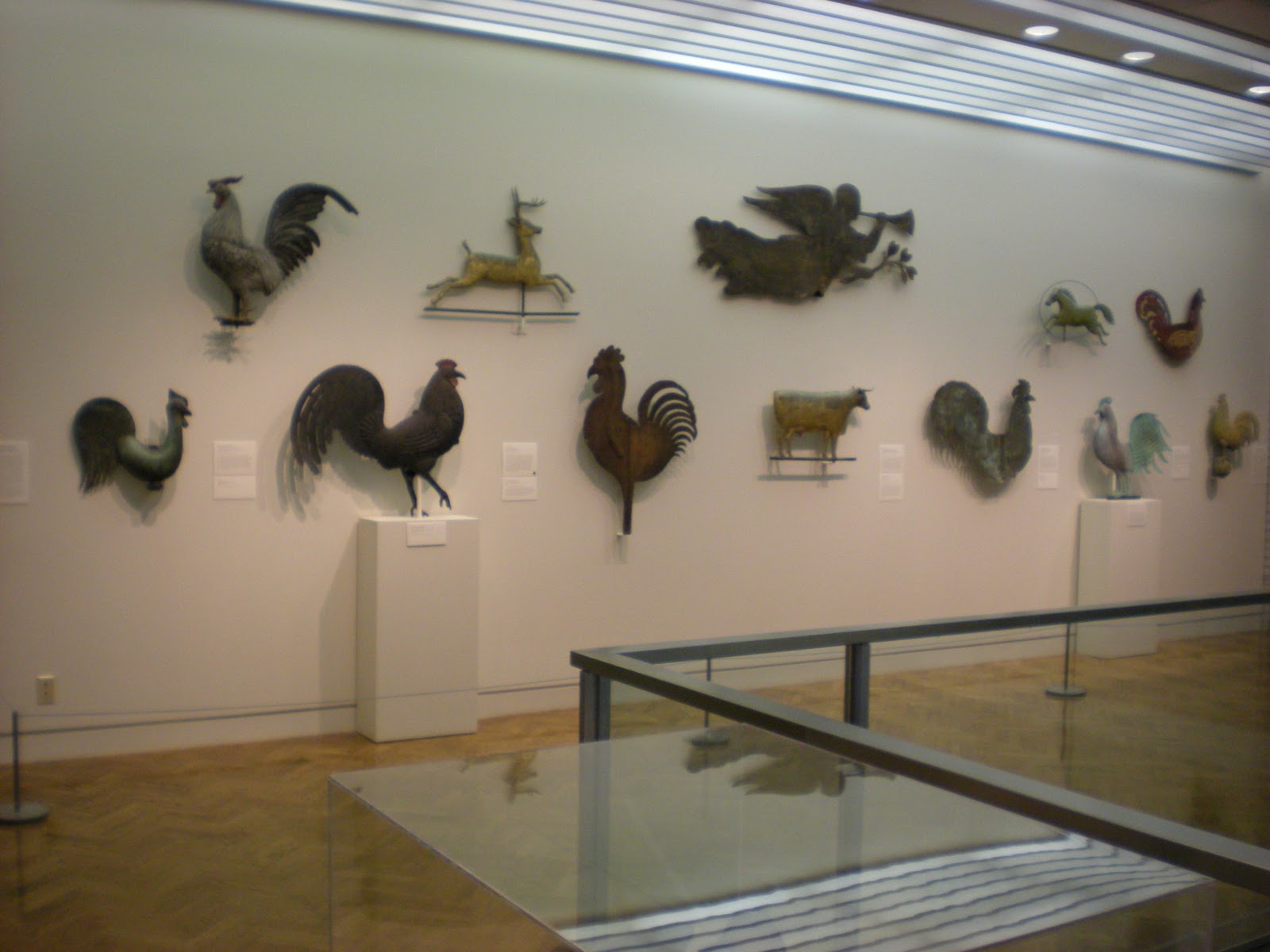
I of course took a closer look. The nearly two dozen vanes were all the gift of a single couple, John and Elizabeth Driscoll of Minneapolis. Their taste was exquisite and far-reaching. The collection included a terrific cast iron vane of a rooster (above) made by the Rochester Iron Works of Rochester, New Hampshire, very similar to one in the Fenimore Art Museum collection. 

In fact, the Driscolls seem to have had a thing for roosters; there were a variety of them in every style and medium possible. My favorite was one (above) that was found on a barn in Red Hook, New York in the 1970s and dates to about 1890. It’s fantastic; not realistic at all but a fun, patterned version of the barnyard fowl. And the paint surface is as good as any weathervane I’ve seen. The vane is boldly striped in red and yellow, which accentuates the curved pattern of the tail feathers.

I also noticed a large Angel Gabriel, which reminded me of our little angel from Nantucket. This one is about five times larger than ours, and it seemed very different in form than the Gabriel vanes I’ve seen over the years. According to the label, it was made for cupola of the Winslow House Hotel in Minneapolis in about 1857. The hotel was a favorite resort for tourists coming to see St. Anthony Falls. Recent scholarship on this vane has apparently yielded some exciting new information about its history, and may explain its appearance.

According to the label, the Gabriel weathervane may have been made in France and displayed at the 1853 World’s Exposition in New York, popularly known as the Crystal Palace Exhibition. It was housed in a grand structure made of glass and resembling a huge greenhouse (above). The label did not indicate where the curators came upon this information, but if it is true this is the documented weathervane I am aware of with such a provenance. And it isn’t common to have French vanes in American collections. 
But if you can discover Japanese folk art in Minnesota, why not an Angel from France?

Saturday, September 25, 2010

Nantucket Angel


Our little Angel weathervane is really a transcendent piece. It’s so unassuming, yet so emblematic of the spirit of folk art that it has taken on a life of its own as a symbol. Over the years it has been our logo as well as an image heralding any number of Americana sales and shops from New England to California. Not bad for a one-inch-thick painted board.

Uncommon luck and persistence, as usual, brought this angel to us. In fact, luck must have followed folk art collector Jean Lipman around where she went in the 1930s and 1940s. She couldn’t open a door, lift up a cover, or look up in the sky without finding some lost and lonely piece that was destined to become a national icon. Our Angel was no exception.


In 1946 Mrs. Lipman visited the island of Nantucket, some thirty miles off the coast of Massachusetts. When she disembarked she was likely already within eyesight of yet another great find. Perched above the peak of one end of a boathouse on Old North Wharf, a block or so from where contemporary visitors disembark for the island, sat our Angel. She overlooked the harbor and could be seen from any number of directions. Her prominence is significant to me in that she must have been seen by countless thousands of people before Jean Lipman recognized what a masterpiece she was and rescued her for posterity.

The vast majority of weathervanes have no history. Those that do are only very rarely photographed in their original locations, making such data priceless. In the case of our Angel, there are TWO period photographs that show her atop the Old North Wharf Boathouse. One is by Samuel Chamberlain (above), and was published in his 1939 photograph book, Nantucket. Our Angel is very hard to see in this photo; just barely visible off to the far right.


Fortunately, another photographer working at about the same time, Louis Davidson, took an image of the boathouses from closer up and at a different angle. This image is breathtaking in its clarity and unquestionable verification of our weathervane’s original location. The photograph even allowed us to identify the specific boathouse on which she rests. It was called “Independence,” and was owned by the Everett family from Hingham, Massachusetts.


The information is as helpful as it is rare, of course. But ultimately it is, for me, the image of our Angel in its natural habitat – the coastal landscape of New England – that says the most about her unknown artist’s masterful embellishment of a truly picturesque harbor.

Tuesday, August 17, 2010

Folk Art In Situ: The County Atlas


I’ve done a number of posts on those great late nineteenth-century weathervanes manufactured by companies in New England and New York and sold via catalogues throughout the United States. These commercially produced sculptures are some of the most elaborate and highly prized Americana items today. Unlike the more humble, hand-made weathervanes done by tinsmiths, carpenters, or farmers, these high-end vanes are difficult to truly classify as folk art, but they have associated with folk art for decades. And no one from the fine art world has ever moved in to take up the slack.

Viewing some of these weathervanes on exhibition in a museum is a terrific close-up experience; bear in mind that one was never meant to see them except from a distance. It is difficult to imagine how they must have looked in their original sites. Photographs of period weathervanes in situ are rare.


But not so rare are the many county atlases that you can find in almost any local library. These volumes, often done in the 1870s by large publishers and sold locally, contain scores of fantastic full-page engravings of some of the more prominent residences in each county. These plates were made from drawings done on site by artists hired by the publisher to solicit this business.

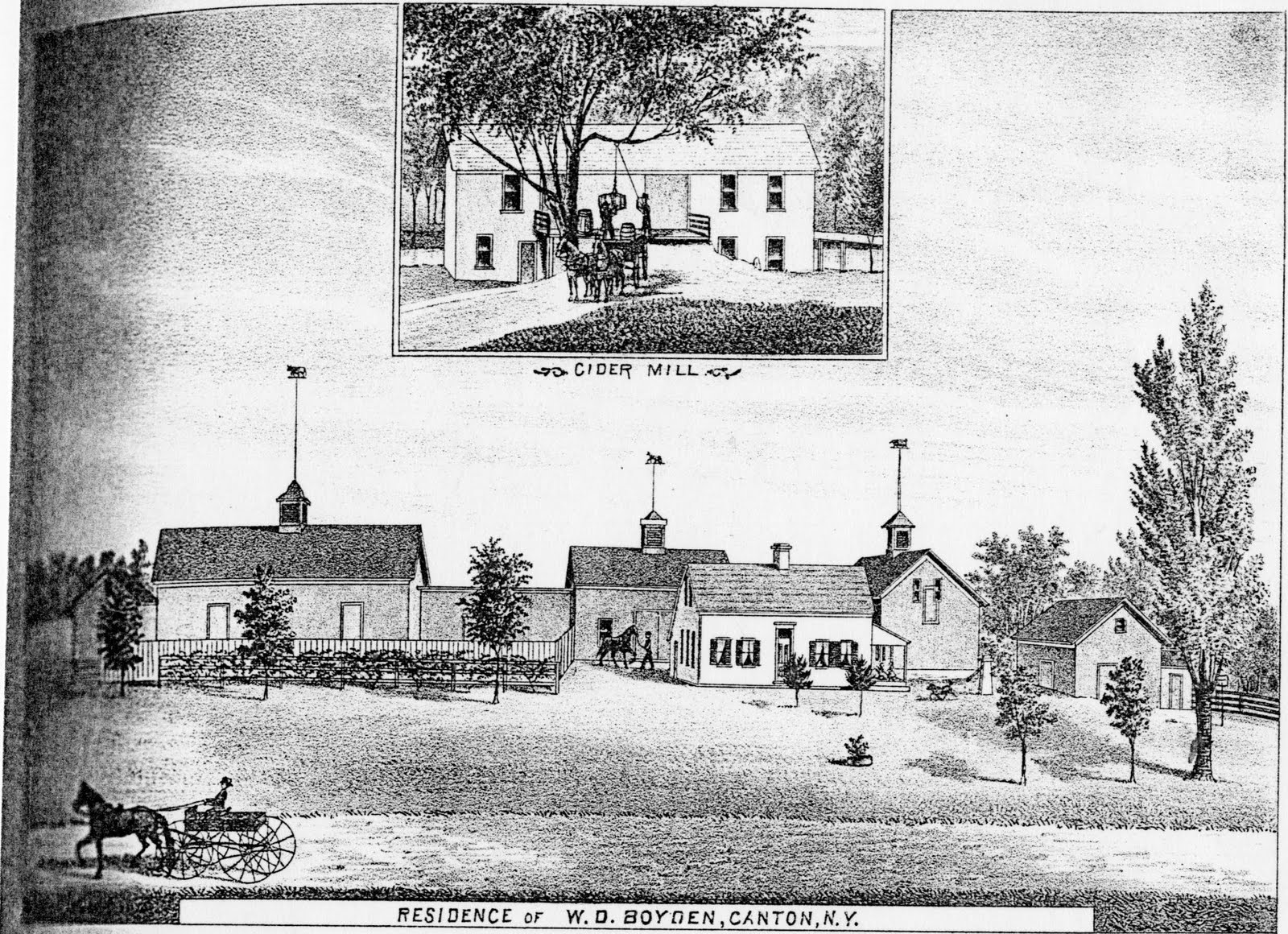
The detail in the engravings is incredible, as it had to be to please the property owner. Leafing through these old books one day some years ago, I noticed that they were a great source of period visual information on the placement of weathervanes in the late nineteenth century. Here are some fine examples.


The residence of Mr. and Mrs. James Slade (above, detail at top) shows not only their lovely brick house, but also their barns at the left. The barn in the back sports a large weathervane of a long horned bull, strikingly similar to the cows on the hillside adjacent. Owners of large scale farms often used weathervanes to signal the type of livestock housed within each barn. The residence of W. D. Boyden (second image from top) show three barns, two with cow vanes and one with a horse. Other vanes are more broadly symbolic of the owner’s life and work; one residence, that of Erie Railroad builder N. H. Decker (below), has a weathervane of a locomotive atop one barn.


Perhaps the most curious vane I found in these volumes came from the residence of Mr. and Mrs. W. Birdsall (below). This is a fantastic estate, complete with two houses, several barns, and a large multi-tiered fountain on the front lawn! But what caught my eye was the weathervane on the barn at the right. Not a horse or a cow or a rooster, but an elephant.


I have never seen a period weathervane of an elephant surviving from the period. It made me wonder whether t his gentleman was somehow involved with a traveling circus. This seems more likely than housing real elephants in that barn. But you never know. These vanes and their owners were so linked that the decorative capstone of one’s home often reflected the lives and ambitions within.

Wednesday, July 28, 2010

The Little Peacock


Here is an object that is more familiar to most as a logo than as a real artifact. It is small carving of a peacock, just about 10” high, made of several pieces of wood and painted in muted tones to mimic the bird’s plumage. It stands on a small carved base with two articulated legs, one positioned slightly ahead of the other as if the bird was walking. The base itself is fascinating; it has a hole in the middle presumably for a dowel or rod, as if it was meant to swivel. But it also has a hole in the front whose purpose is unknown.


The most prominent feature of this little carving is the peacock’s tail, which is magnificent even on such a small scale. The tail, a separate piece of wood, has a lively scalloped edge and is scored along the wood grain to give it texture. Most important, the unknown artist of this piece turned the tail parallel to the body to give it the maximum visual impact when view from the side. It is this distinctive profile that has given this bird its greatest fame. We have over the years used the peacock as a logo for our educational programs and activities, including the annual Seminars on American Culture back in the 1950s.


Very little is known of the peacock’s origins, unfortunately. It was purchased for the Fenimore Art Museum from the Boston dealer Isabel Carleton Wilde in the 1950s, but she left no record of where she acquired the piece. Wilde was a very influential figure in the early appreciation of American folk Art, and items from her collection are highly prized. This peacock is proof of her keen eye for the most seemingly humble pieces of folk sculpture.


So what was it? A small weathervane? Or a toy of some sort? There is no easy way to tell, but one thing is for sure: our little peacock occupies an oversized place in the field of American folk art. These birds always get attention when they show their feathers.

Friday, July 23, 2010

Mare and Foal


Let’s face it; people love folk art not just for the vibrancy of its patterns and colors, but also for its simple and enduring charm. The best folk art speaks of relationships of the heart. We have many such pieces in the Fenimore Art Museum collection, but few speak to this basic human need as well or as directly as our well-known Mare and Foal weathervane.


As weathervanes go, this piece (about 31”long) is pretty simple. It consists of a flat, one inch thick piece of wood that was marked and cut into the silhouette of a draft horse sometime around 1850. Sometime later, someone added a miniature version of the horse at the back of the vane, perhaps to balance it properly so that it swung in the wind better. You can tell the small horse is a later addition (perhaps even by a different artist) by looking closely at the construction of the vane as well as the manner of carving. The smaller horse rests on a separate piece of wood that has been joined to the main body of the vane, and it is carved in the round rather than as a flat silhouette like its larger counterpart.


The smaller horse does much more than balance the vane, however. It clearly evokes a small foal chasing after its mother; just the sort of image that tugs at the heartstrings. It is perhaps this quality that first drew the attention of the great folk art collector Jean Lipman when she first saw the piece in Wakefield, Rhode Island in 1947. Not only is the silhouette pleasing and evocative, but the artist also incised the vane, adding manes to both horses and a proud smile of the face of the mother. It must have been irresistible.


What is somewhat unusual for a Lipman piece is that this weathervane was not undiscovered at the time she purchased it. In fact, it had caught the attention of an artist for the WPA who rendered the vane in watercolor for the Index of American Design in the 1930s, and it was exhibited at the Rhode Island School of Design in the early 1940s. I guess we can count ourselves fortunate that the piece was not acquired prior to Mrs. Lipman finding it on one of her legendary New England jaunts.


I’ve added some fine art examples of the same subject here (by Edwin Cooper and Basil Bradley, respectively) for two reasons: to show that the idea of a mare and foal was not unheard of in the art world of the nineteenth century; and to demonstrate that the unknown folk artist could produce, even with a saw and a block of wood, as good a representation of this subject as anyone. Maybe better.

Friday, July 9, 2010

The Folk Art Skyline of London


It’s been awhile since I’ve posted anything, owing mainly to a great vacation trip I recently took to London. It was a family vacation, not a business trip, but as always I kept an eye out for great examples of folk art that would be useful and interesting comparisons to the traditions we have here in the United States.


I was not disappointed. Although the majority of the art shown in London museums reflects the voracious collecting of the British Empire (including cultures from across the span of recorded history and from around the globe) and in particular the enormous decorative arts collections of Queen Victoria and Prince Albert in the 19th century (mostly in the Victoria and Albert Museum), there were examples of folk art to be seen.


Only not in museums. Londoners, unlike Americans, live with their folk art in plain sight every day. The most obvious example of this phenomenon is the stunning array of gilded weathervanes that grace the skyline of the capital. Anywhere you happen to be in London, all you have to do is point your camera skyward and the chances are pretty good that you will catch a glint of sunlight (yes, we had great weather all week!) reflecting off a large weathervane.


You can find these vanes on churches, public buildings, row houses, and businesses. Since I was not able to see any up close I could not tell how many of them were old, but my guess would be that a good number are at least 19th-century examples. This is very different from what you would expect in an American city. It is also a reminder that the weathervane tradition is European in origin, and the weathervane industry in the United States followed the industrial model of England in particular.


So I hope you enjoy these snapshots of the beautiful artworks that may seem incidental to Londoners, but were remarkable integrations of art into everyday life when seen through my American eyes. In the coming weeks I’ll post more of what I saw on vacation, including some wonderful sculptures tucked away like prisoners in the Tower of London.

Monday, December 21, 2009

A Champion Bull


We have some magnificent animals at The Farmers’ Museum in Cooperstown, and some equally stunning counterparts in the Fenimore Art Museum’s folk art collection. This bull is one of the best of its type to be found anywhere. One of the biggest too, at 44 ½” long and 31” high. It’s a wood carving, but not meant to be seen by anyone in its current form. That’s because this bull was simply a model for a copper weathervane rather than a finished work of art on its own.

All of the great copper weathervanes, with fully articulated bodies, were originally hand carved in wood by a highly skilled artist. These are rare survivals, since they were not highly valued once the manufactory went out of business. It is very fortunate indeed that this bull was not tossed away. A sharp-eyed dealer named Adele Earnest saved it and we purchased it from her Stony Point Antique Shop in Stony Point, New York in 1954.

The process of taking a wood pattern and creating a copper weathervane required several steps. Nineteenth-century commercial manufacturers followed the steps listed below, with some variations, to produce hollow-bodied copper weathervanes from wooden models like our bull.

How Commercial Weathervanes Were Made
Step One: Artisan carves full-scale model in wood.
Step Two: The model is cut into component parts (see the front view below that shows the bull cut in half down the middle. There are seams for his head, horns, legs, and tail too).

Step Three: Cast iron molds are made from each of the parts of the wood model.

Step Four: Artisan hammers sheet copper into the molds to force the copper into shape.

Step Five: Copper is removed, and additional details are hammered by hand.

Step Six: Copper parts are soldered together, seams smoothed and polished.

Step Seven: Figure mounted on brass tube and gilded.

For any given design, steps one through three had to be done only once. Many weathervanes could be made from the molds before they showed any signs of deterioration.

Large weathervane manufactories such as L. W. Cushing and sons employed professional woodcarvers to carve the patterns. Other artisans would do the metalwork to finish the vane. The weathervane industry is one place where hand craftsmanship and mass production merged to create a large supply of beautifully wrought and decorative vanes to grace houses, barns, and public buildings across the country.

And like so many other folk artists, their cast-offs are as interesting as the finished product.
Blog Widget by LinkWithin