Showing posts with label Miss Liberty. Show all posts

Sunday, August 1, 2010

Shady Lady


Frederick William Fuessenich earned his living in Torrington, Connecticut in the workaday world of numbers crunching. When he was young (Frederick was born in 1886) he got a job as a bookkeeper for the Hendey Machine Company of Torrington, eventually rising to the post of treasurer and director. He must have been very good with numbers, since after leaving the Hendey company, Frederick became president and director of the Torrington Realty Company as well as president and director of the Berkshire Mortgage and Finance Corporation. Sound dull? Well, Frederick had another life altogether, one that left a lasting impact on the Fenimore Art Museum folk art collection.


Frederick was very proud of his family’s roots in New England. Although his father emigrated to Connecticut in the 1850s from Prussia, Frederick’s mother’s family (Blake) was among the earliest settlers of the state. At some point in the early 20th century, Frederick became enthralled with the early history of New England, and began to pursue that history with passion.


He purchased one of the oldest and most storied taverns in Connecticut, the William Bull Tavern of Litchfield, which was built in 1745, and moved it to his property. Over the years Frederick restored the tavern as his family’s residence and filled it with antiques. In the 1920s the Litchfield Enquirer said of his historic home: “Nowhere else in Litchfield, nor in all Connecticut, does one have the close, elbow-to-elbow touch with the dim yesterday of Colonial days that one enjoys in the one-time tavern, now the Fuessenich home.”
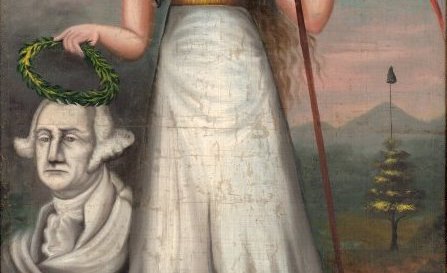

In late 1928, Frederick decided to sell his collection of antiques. Among the pieces offered for sale was a large painting (73” X 44”) depicting the figure of Lady Liberty placing a laurel wreath on a bust of George Washington. Frederick had purchased this work from a Connecticut inn; it was one of a set of six, five of which were destroyed in a fire. It was a remarkable survival and a terrific early American painting, but there’s something else about it that makes it truly stellar.

It was a window shade. One of six that graced the interior of the inn they were painted for in the early years of the 19th century. It is not known where this tavern was, who painted these works, or even what the five shades depicted, but this one is chock full of the symbols that were coming to be identified with the young republic of the United States. Not only do we see the figure of Liberty and the bust of Washington, but also the American flag, the pine tree and Liberty cap (in the background), the eagle (albeit smallish and off in an upper corner), and the crown of England which Lady Liberty tramples. This last detail is always a favorite of our visitors from the UK.


The Liberty window shade was purchased by Elie Nadelman, the modernist sculptor/folk art collector I have blogged about several times. It was purchased for the Fenimore Art Museum from his estate in 1948.

Every time I pass by this painting in our folk art gallery I think of the history it witnessed in its original tavern setting beginning in about 1805, an emphatic statement of liberty when the United States was a mere 22 years old.

Monday, November 23, 2009

Hidden Jewell

It was a gilded age, to be sure. Lavish mansions in cities large and small, palatial homes by the sea, even large and prosperous farm complexes dotting the rural landscape. The late nineteenth century was definitely a time when homes, furnishings, and decorative accessories became elaborate and highly ornate. This was particularly true of one area of folk art that could be seen virtually anywhere in America: weathervanes.

Weathervanes of the Gilded Age were largely produced by large companies like L. W. Cushing & Sons of Waltham, Massachusetts and J. W. Fiske of New York. These manufacturers employed craftsmen to create copper vanes in a wide variety of types and styles in multiple sizes (often covered in gold leaf; that’s the “gilded” part) to be sold in catalogues that were distributed everywhere. They were mass-produced, but still hand crafted, thus maintaining a connection with the idea and spirit of folk art. As you might imagine, these vanes are highly prized, and have been for decades. You can forget about buying an authentic one with a solid provenance, unless you have too much money to sit around reading folk art blogs. Some bold thieves have even tried to steal these vanes from cupolas and steeples from helicopters, but this is not recommended. It is an act of air piracy and a Federal crime.

We have, in the Fenimore Art Museum collection, two prime examples of this form of American sculpture. The first is a grasshopper weathervane attributed to L. W. Cushing & Sons and made about 1885. I highlighted this piece in my October 1 post.

The other example, our Goddess of Liberty weathervane, has an even more interesting history. It was thought to be by Cushing too, but it has a patent date of September 1865 on its base. Cushing did not go into the weathervane business until 1867, when he bought an established business at auction. That business belonged to the pioneer of the commercial weathervane business, Alvin Jewell. Jewell started manufacturing weathervanes in 1852, along with other cast-iron and brass products for the home. He was the first to market his weathervanes in catalogues, and his repertoire included the Goddess of Liberty. Tragically, Jewell died in a fall from a scaffold in 1867 (this must have been an occupational hazard). When Cushing bought the business, he also purchased all of Jewell’s molds, thus enabling himself to reproduce all of the favorite vanes. That’s why it is so hard to tell a Cushing from a Jewell. See, for example, the Cushing version of the Goddess of Liberty in his 1883 catalogue at upper left.


In this case, however, we have the patent date as proof. Since Jewell was the only one making these goddesses in 1865, we now realize that we may have the only documented Goddess of Liberty by this important innovator. A Jewell indeed.
The images of the 1883 L. W. Cushing & Sons catalogues are courtesy of the Archives of American Art, Smithsonian Institution.
Blog Widget by LinkWithin