Showing posts with label Maritime Folk Art. Show all posts

Tuesday, January 25, 2011

Crossing the Atlantic at the Winter Antiques Show


I just returned from my annual January visit to New York City and the Winter Antiques Show, and have several interesting discoveries to share. This is a show not to be missed; there are dozens of dealers representing a wide range of interests from fine art to ancient art to tribal art and, of course, American folk art. You may or may not go there to buy, as the prices are consistent with what you might expect from an antiques show on Park Avenue, but the looking is its own reward. You can educate your eye more fully in an hour here than in weeks of seeking out individual shops in the many regions from which these dealers come. And the setting is glamorous, as you can see by the entrance to the show below.


While wandering through the show, I kept an eye out for pieces that had certain similaities with ones in the Fenimore Art Museum collection. Here's a good one.


This life-size carved wooden figure depicted a mariner holding a sextant. It is beautifully carved, probably in a large ship carver's shop. At first glance i would have thought it to be American, but according to the label it is English. The piece is attributed to a carver named Thomas Hall Tweedy, who reportedly carved it for a natical instrument maker's shop (the dealer even gave the name of the shop: John Cail!) in Newcastle on Tyne.

This figure undoubtedly sat outside the shop on the sidewalk, like a cigar store figure. But it reminded me so much of a little figure in our collection I just had to photograph it and share it here. Our figure is even mentioned in the dealer's label for the large piece.


Our little mariner is only about 25 inches tall, but it depicts the mariner holding the sextant in the same manner as the large figure. Our is, of course, much more primitive than the large one. But very appealing for those who have an eye for folk art. Our piece was found in New Bedford, Massachusetts, and is thought to have come from a nautical instrument maker's shop in that important coastal city. The small figures would generally be displayed either on countertops or, as I have seen in one period photo, outdoors on a cantilevered mount above the shop doorway.


However separated by thousands of miles of ocean, these two pieces remind us of the seafaring culture that binds the hemispheres. This notion has gained such credibility in recent years that historians speak less and less of American or European history and instead study Atlantic history. Or, as the Mystic Seaport Museum in Mystic, Connecticut, is fond of saying: the sea connects us all.

Friday, August 20, 2010

River of Life


Thanks to a recent grant from the Greater Hudson Heritage Network, one of our most important folk art masterpieces is going to be conserved and prominently displayed in the Fenimore Art Museum’s 2010 quilt exhibition.


The piece is considered one of the greatest American quilts of all time, and one of the very few that feature a pictorial narrative akin to the genre paintings of the era. It is our Trade and Commerce quilt by Hannah Stockton Stiles, a 105” x 89” bedcovering made of cotton and chintz in about 1835. Hannah was born in Trenton, New Jersey and married John Stiles of Philadelphia in 1818. The two cities flank the Delaware River, a bustling commercial waterway that in the 1830s was loaded with all manner of ships, wharves, dockworkers, taverns, and shops taking advantage of the immense maritime traffic.


When Hannah decided to create a quilt, no doubt she wanted one that reflected her life. Whereas many quilters chose established patterns – often adding or creating variations on those patterns that were their unique individual stamp – Hannah did something quite extraordinary. She cut her own designs and images to make a complex and lively rendition of life along the river.

Her centerpiece for the quilt is highly symbolic, an immense Tree of Life. She borrowed this image and tradition from the imported palampores of India, but the notion of a life-giving river that provided everything for the people along its banks is central to the artist’s intent.


Along the margins of the quilt, Hannah did her most extraordinary work. Cutting out and applying her own shapes, she made figures of people and buildings and barrels and ships, all in the course of their daily business. Her level of detail is astounding, as you can see in these pictures. One can see a woman milking a cow, a fancy town carriage near a public bath, barrels being loaded or off-loaded at a wharf, and much more. She went so far as to cut zig zag shapes from her fabric to mimic the steam coming out of the steamboats on the river.


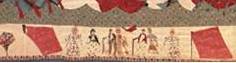
And look, lastly, along the bottom of the quilt. You can see a row of well-dressed people standing together as if watching the whole scene unfold. Might this be the Stiles family themselves, including the artist, paying homage to the life force that had given them everything they had?

Saturday, April 10, 2010

The Tipsy Mermaid


Sometimes you just have to tilt your head sideways to get a new perspective.

        In the folk art collection at the Fenimore Art Museum we have many pieces that are among the earliest published artworks in the field. The reason for this is that they come from the collection of Jean Lipman, who published the seminal books American Primitive Painting and American Folk Art in Wood, Metal and Stone in the 1940s using many pieces in her collection as illustrations. When our benefactor Stephen C. Clark purchased the Lipman Collection for us in 1950, it gave the museum iconic artworks well known to a generation of folk art enthusiasts.

            One of those pieces is our great Mermaid Garden Fountain. It was found in Baltimore and came with the history that it was displayed in a shop window in the early 19th century as a garden ornament for sale. The style of the carving suggests that it was the work of a professional shipcarver.

            The Mermaid appears on page 150 of Lipman’s Wood, Metal and Stone and she had this to say about it. “A metal tube ran up the body to the mouth, allowing the mermaid to spout water which must have risen and fallen in a curve, repeating in reverse the lines of her sweeping tail… This figure is naïve indeed but it is just the type of wood sculpture from which our modern sophisticates have derived inspiration."

            But something is wrong here. When she was photographed for the book, the Mermaid was positioned with a vertical torso. Probably because of this image, this was the way she was exhibited and published in Cooperstown and elsewhere for almost 50 years. About ten years ago I came across a notation buried deep within her research file. It happed to mention that the Mermaid was probably tilted on a 45 degree angle to allow the water to actually spout forward in a graceful arc.


            I was struck by this casual note. Of course! If she was vertical, the water would spout straight up and come back down on the poor Mermaid’s face! Tilted forward, the torso and the tail are incredibly well-balanced, and she resembles the forward-leaning ships’ figureheads of the era.

            So now, after a half century of misrepresentation, she leans again, and illustrates for our visitors the visual dynamism of early folk sculpture. 

Tuesday, March 16, 2010

A Whale of a Cane

There are literally hundreds of great artworks in the Fenimore Art Museum’s folk art collection, and our main folk art gallery only holds about 75 – 100 of them. So it stands to reason that you will occasionally find phenomenal masterpieces in storage, usually when touring a collector through the stacks and smiling politely when they look at you aghast at seeing such wonderful stuff not on view.


A few years ago we had the great pleasure of hosting a group of folk art collectors here in Cooperstown. One of them is an expert on early American scrimshaw. When he saw what we had in storage he was very surprised, and much more polite about it than he needed to be.

In a far corner of our storage facility, stacked in a vertical unit with a host of other walking sticks, is one of the greatest scrimshaw canes in America. Who knew?


It’s not scrimshaw in the strictest sense of the word. Scrimshaw developed in the early 19th century with the rise of the commercial whaling industry. It was a leisure activity of the whalers who endured long voyages in pursuit of Sperm whales whose oil (from the blubber under their skin) was widely used for lighting. Scrimshanders (as scrimshaw artists were called) engraved images into the teeth and jawbones of the whales, and then covered them with a dark pigment that, when wiped away, left dark lines where the bone was incised. The images ranged from portraits to patriotic symbols to pictures of ships and far-off ports.

Our cane was likely made from the jawbone of the whale, and rather than having incised designs it features mother-of-pearl and tortoise-shell inlay as its main design element. The range of images is remarkable, and includes Sperm whales, boats, American eagles, and even the figure of Miss Liberty holding a Liberty cap and, in another image, a flag. The cane is about 35” long, and the maker is unknown. The date is also hard to ascribe, but I would guess it to be 1825-1850.

This treasure of our maritime past will be on view for all to enjoy in our folk art gallery starting on April 1st.

And trust me, I’ll make sure our collector friend knows it’s out of storage.

Thursday, November 26, 2009

A Mistake of Epic Proportions

When it comes to scholarship on works of art, nothing trumps common sense. A couple of days ago I was reminded of this while walking through our storage facility and glancing across the room at a large ship’s figurehead that we have had in the Fenimore Art Museum collection for many years. I’ve seen it many times, of course, and have never really given it the attention it deserves. This time, I did a double-take.

The figurehead came to us from the Jean and Howard Lipman Collection, and was said to depict Hercules. In fact, it came with a great history: it was reportedly made for the ship “Herculean” out of Kingston, Massachusetts, built in 1839 and used primarily for the shipment of cotton from the southern United States to New England and on to Europe. According to the history of the ship, during one particular voyage in 1849 the Herculean put into port at Glasgow, Scotland with numerous leaks. These leaks were allegedly caused by having too much weight in the bow owing to the 800 lb. figurehead mounted there. When the ship returned to Boston the figurehead was said to have been removed and replaced with a smaller, lighter billet-head.
The figurehead’s story from that point on is remarkably detailed. Sources say it was brought to the Holmes shipyard, where the Herculean was built, and mounted to the second story of the rigging and sail loft. After the building was torn down, the figurehead lay in the sand among the cast-off timbers of the yard for years until it was rescued by a local man who placed it among the shrubs of his garden in Kingston. After a time there it disappeared.

We acquired the figurehead from Mr. and Mrs. Lipman in 1950. It is not known when or where they purchased it, along with the history above. It’s a great story, and the residents of Kingston were delighted to find the piece in our galleries, with the label detailing its history, in 1953.

The problem is simple. Look at the figurehead.

A toga? A scroll in the right hand? I’m not a classically trained scholar, but I have no recollection of ever hearing about or reading the Writings of Hercules, or the Speeches of Hercules. I’m not even sure he could read or write. Common sense tells me that this figurehead cannot be Hercules, and the connection with the Herculean must have a glitch somewhere.

Fred Fried, the preeminent scholar of folk sculpture in the 1970s, agreed when he saw this figurehead in 1970. A note from him tucked away in our research file states that he felt that carvers, even folk carvers, had a pretty good sense of their iconography. Look, for example, at the Hercules figurehead from the U.S.S. Ohio, now on display in Stony Brook (above).
Now that’s Hercules.

So who do we have? A Roman statesman, perhaps. That’s a problem we now have to confront. When we do, hopefully common sense will guide us.

Monday, November 9, 2009

A Hudson River Steamboat Collision, Kind of


The denizens of the Potters Hollow Tavern in Greene County, New York probably scarcely noticed the crudely painted river scene at their feet. Set into a panel about seven feet long, and mounted under the bar at the tavern, was a painting of the Hudson River complete with steamboats, mountains, grazing animals, and even a train in the foreground. If any of them chose to bend down and look closely at the painting, they might have realized that this was no ordinary day on the Hudson. They might even have seen that the work seemed unfinished, with odd pencil outlines behind the boat at the left.

This panel painting (now in the Fenimore Art Museum collection and seen here in our storage facility) is meant to depict a well-known local story about a collision on the Hudson River that occurred between the steamboats Charlotte Vanderbilt (seen here at the right in the photo above, and in the detail below) and the Yosemite (depicted on the left in the photo above and at the lower left of this post) on the night of July 14, 1882. Looking at the picture, anyone can see that there is no collision happening. That’s the point: the artist chose to depict a collision ABOUT to happen, for a very particular reason.

On the evening in question, the Charlotte Vanderbilt left Catskill Point and headed downstream for New York. She carried only the captain and his family along with the pilot. At a point on the river near Rhinebeck (55 miles south of Albany), the captain saw the lights of another vessel. The steam yacht Yosemite was running upriver at maximum speed. The Yosemite, however, was an ocean-going yacht and carried different running lights than the river boats. The captain of the Charlotte Vanderbilt misread the lights, thinking that the Yosemite was a steamer hauling two barges. At the last moment, he swerved to avoid the phantom barges, crossing right into the path of the Yosemite. The Charlotte Vanderbilt was sliced in half and sunk, but no lives were lost.

Why did the artist not depict the collision? Those pencil outlines on the left give the answer. They are, in fact, the phantom barges that caused the collision in the first place. The artist has used a novel way to show the regulars at the Potter’s Hollow Inn that those barges are not present; except in the mind of the captain of the Charlotte Vanderbilt. The case eventually went all the way to the Supreme Court, and was eventually decided in favor of the owner of the Charlotte Vanderbilt. With no loss of life, the cause of the crash was obviously a better drinking story than the effect.

Thursday, October 8, 2009

Folk Art in Moby-Dick

The greatest scholars, and the greatest writers, have an insatiable curiosity and an abiding respect for all humankind. This broad and far-reaching humanism is rare in any field, but there are dramatic exceptions. Herman Melville is one of these bright spots.

Folk art was appreciated by a few enlightened individuals by the 1920s, and only gained widespread acceptance in the 1970s. This is why it is astonishing to me that Melville thought enough of the material to devote a chapter to it in the middle of his classic Moby-Dick way back in 1851. In this chapter, entitled “Of Whales in Paint; in Teeth; in Wood; in Sheet-Iron; in Stone; in Mountains; in Stars,” Melville describes an old sailor on the London docks, displaying his stump of a leg and a painting of the whaling incident that cost him his appendage. Three whale boats, three whales. One whale crushing a boat – and the sailor within – in its massive jaws. In a statement that would only provoke derision until more than a century later, Melville proclaims “His three whales are as good whales as were ever published in Wapping [a dock district in London].”

Melville goes on to praise all manner of folk art of the sea, including whaling scenes like that described above (and the ones in the Mystic Historical Society, left, and in the Fenimore Art Museum collection below) and especially scrimshaw (the incising or carving of scenes or figures into whale teeth or bone, such as the Frederick Myrick tooth at the bottom) as “lively,” “ingenious,” and “miraculous.” He compares the scrimshander’s “maziness of design” with the legendary patterns of Achilles’ shield and the woodcuts of Albrecht Durer.


Radical words for 1851. And written by someone who knew his subject, knew how to capture a whale in body and spirit. Melville’s profound respect for sailors and their artwork is instructive and inspirational. It shows us how powerful and relevant the works of folk artists can be.

Especially when your art studio is a bunk below decks and you have to fit in your carving time between marathon fights to the death with a pale behemoth.
Blog Widget by LinkWithin