Showing posts with label Jean Lipman. Show all posts

Friday, July 22, 2011

The Little Farmer


Here is a small watercolor, about 4" x 7", that I have always liked. It was purchased from a landlady in New Bedford, Massachusetts by Jean Lipman in the 1940s, with little or no history as to who painted it and where it was from. It has been in the Fenimore Art Museum collection since 1950.


It depicts a small farmstead with a nice house (possibly stone with tile shingles), a well, and a farmer holding a two-pronged pitchfork and walking a dog on a leash. That's about all we know, believe it or not. The painting has always been called "The Amish Farmer" owing to the distinctive beard and hat of the man, but that is a tenuous identification at best.


All that aside, the little watercolor has out-sized charm, doesn't it? We displayed it in our folk art gallery last year and it received considerable attention. I was hoping that someone would provide some clue to its origin, but, alas, it remains one of our anonymous treasures.

Tuesday, December 21, 2010

Midwestern Master: Paul Seifert


When one looks at idyllic farm scenes like this piece, one almost always thinks of an artist peacefully whiling away his time in the countryside making these images for interested people found along the way. That’s only partly true. Paul Seifert, the artist of this beautiful watercolor of the farm of Mr. E. R. Jones, had a fascinating life that led him from the chaos of mid-19th-century Germany to the American frontier.


According to his granddaughter, Seifert was born in Germany in 1846, and probably saw a lot of upheaval in his early years, including the revolutions of 1848. He studied engineering at the University of Leipzig but fled Germany in 1866 to avoid being conscripted into military service during the Austro-Prussian war. He came to New York and took the Erie Canal westward, arriving in Milwaukee in 1867. From there the journey got really interesting.


Seifert wanted to continue westward, so he jumped on a lumber raft (see my previous post on Linton Park and the lumber rafts of Pennsylvania) for a 100-mile ride down the Wisconsin River. No pleasure cruise, I’m sure. As the raft approached Richland City (later named Portage), near the confluence of the Wisconsin and Pine Rivers, he must have seen something he liked. He dove off the raft into the river and swam ashore. Sitting on the shore was a group of young girls (maybe the reason for the dive?) that included a 16-year-old Elizabeth Craft. She later recalled Seifert struggling onto the bank looking like “a drowned rat.” They were married the following year.


Paul and Elizabeth built a log cabin on the banks of the river and worked very hard to create an 80-acre truck garden, from which they sold vegetables to people in Gotham, two miles away. Seifert “trucked” the produce there by wheelbarrow. He earned extra money as a taxidermist and craftsman to help support their growing family of four daughters.

In 1875, Seifert decided to try his hand at painting. He packed his bags with paper and paints and went on the road in search of farmers who would be willing to pay $2.50 for a view of their farm. The paper was large, often 21 x 27 inches, so the resulting image made quite an impression. Over the course of the next decade he made about 100 of these drawings, mostly in Richland, Grant, Sauk, and Iowa Counties in southwestern Wisconsin.  Seifert died at the age of 80 in 1925, and his artwork didn’t receive any accolades until it was discovered by Jean Lipman in the 1940s. It was from Lipman that the Fenimore Art Museum acquired this piece.


Seifert painted the farm of E. R. Jones of Dodgeville (seen today in the photo above) in 1881. It is different from many of his works in that it shows the farm in late autumn or early winter, just after a snowfall. The blanket of freshly fallen snow contrasts nicely with the autumn colors still visible of the trees. The beauty of the work lies not only in the palette, but also in the impeccably clean, smooth lines of paint used to distinguish the buildings, figures, and landscape.

One tidbit of information makes me wonder whether Seifert’s painting was meant to be represented in the Fenimore Art museum. Just over twenty miles to the west of Dodgeville is a town the artist must have known in his travels: Fennimore, Wisconsin.

Friday, July 23, 2010

Mare and Foal


Let’s face it; people love folk art not just for the vibrancy of its patterns and colors, but also for its simple and enduring charm. The best folk art speaks of relationships of the heart. We have many such pieces in the Fenimore Art Museum collection, but few speak to this basic human need as well or as directly as our well-known Mare and Foal weathervane.


As weathervanes go, this piece (about 31”long) is pretty simple. It consists of a flat, one inch thick piece of wood that was marked and cut into the silhouette of a draft horse sometime around 1850. Sometime later, someone added a miniature version of the horse at the back of the vane, perhaps to balance it properly so that it swung in the wind better. You can tell the small horse is a later addition (perhaps even by a different artist) by looking closely at the construction of the vane as well as the manner of carving. The smaller horse rests on a separate piece of wood that has been joined to the main body of the vane, and it is carved in the round rather than as a flat silhouette like its larger counterpart.


The smaller horse does much more than balance the vane, however. It clearly evokes a small foal chasing after its mother; just the sort of image that tugs at the heartstrings. It is perhaps this quality that first drew the attention of the great folk art collector Jean Lipman when she first saw the piece in Wakefield, Rhode Island in 1947. Not only is the silhouette pleasing and evocative, but the artist also incised the vane, adding manes to both horses and a proud smile of the face of the mother. It must have been irresistible.


What is somewhat unusual for a Lipman piece is that this weathervane was not undiscovered at the time she purchased it. In fact, it had caught the attention of an artist for the WPA who rendered the vane in watercolor for the Index of American Design in the 1930s, and it was exhibited at the Rhode Island School of Design in the early 1940s. I guess we can count ourselves fortunate that the piece was not acquired prior to Mrs. Lipman finding it on one of her legendary New England jaunts.


I’ve added some fine art examples of the same subject here (by Edwin Cooper and Basil Bradley, respectively) for two reasons: to show that the idea of a mare and foal was not unheard of in the art world of the nineteenth century; and to demonstrate that the unknown folk artist could produce, even with a saw and a block of wood, as good a representation of this subject as anyone. Maybe better.

Tuesday, May 25, 2010

Revelations in a Cemetery


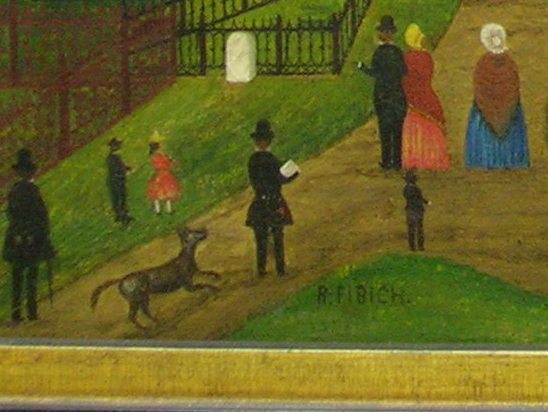
This painting, another of our folk art icons, has long been a mystery. It is an oil on canvas, about 18” x 24”, showing a group of people in a cemetery who seem to be awaiting a carriage coming toward them from the background. The earliest known owner was an antiques dealer from York, Pennsylvania, in 1939. It was purchased from him by Jean and Howard Lipman, and became one of their signature pieces which Jean published in her 1942 book American Primitive Paintings. The Fenimore Art Museum acquired it via Stephen C. Clark in 1950 with the rest of the Lipman collection. Owing to a notation on the frame, “Found in York Springs, Pa.,” the painting has always been known as York Springs Graveyard. It is signed by an “R. Fibich,” about whom nothing was known.


A research nightmare. Museum staff and Cooperstown Graduate Program students quickly ascertained that the cemetery in York Springs bore no relation to the one depicted. It seemed impossible to tell with any certainty what was actually going on in the picture: were the people waiting for a dignitary to arrive on the outskirts of town? They certainly didn’t seem dressed for a funeral. So the painting kept its uncertain title and was published as the only known work by an R. Fibich, painted about 1850, in various publications from the Whitney’s seminal exhibition catalogue The Flowering of American Folk Art, 1776-1876 in 1974 to Life magazine.


That all changed in 2008, when Judith Pyle, a researcher from Adams County, Pennsylvania with childhood ties to York Springs took up the cold case of R, Fibich. Using local historical society archives, Judith found the citizenship application and tax assessment listing for a Robert Fibich, born in Prussia about 1820 and living in Reading, Pennsylvania in 1856. He was listed in city directories as a painter. In 1865 he moved to Tamaqua, about 45 miles north of Reading. He died in 1878. No other R. Fibich could be found in the census records, so it’s a safe bet that this was our man. In fact, Fibich signed his citizenship application in the same block letters that appear in his signature on the painting.


The move to Tamaqua led Judith to more information about the locale depicted. She already knew that the cemetery in the painting did not look like the York Springs cemetery. The most distinctive feature in the painting is the pair of triangular shaped plots at the left; nothing of the sort could be found in any local cemetery. Judith, however, paid a visit to the Odd Fellows Cemetery in Tamaqua, which resembles the contours of the land in the painting. Standing in the area at the left side of the painting, which was now a plain surface of mown grass with no iron railings, she asked the sextant, Justin Bailey, about the plots.


“Well,” he said, “first of all, the plot is triangular.” The railings had been removed and melted down during World War II as part of the war effort. That clinched it.

So, where we once had York Springs Graveyard, R. Fibich, ca. 1850” we now have Scene in Odd Fellows Cemetery, Tamaqua, Pa., Robert Fibich (ca. 1820-1878), ca. 1875.”

There’s nothing like a good sextant when you need help navigating.

Saturday, April 10, 2010

The Tipsy Mermaid


Sometimes you just have to tilt your head sideways to get a new perspective.

        In the folk art collection at the Fenimore Art Museum we have many pieces that are among the earliest published artworks in the field. The reason for this is that they come from the collection of Jean Lipman, who published the seminal books American Primitive Painting and American Folk Art in Wood, Metal and Stone in the 1940s using many pieces in her collection as illustrations. When our benefactor Stephen C. Clark purchased the Lipman Collection for us in 1950, it gave the museum iconic artworks well known to a generation of folk art enthusiasts.

            One of those pieces is our great Mermaid Garden Fountain. It was found in Baltimore and came with the history that it was displayed in a shop window in the early 19th century as a garden ornament for sale. The style of the carving suggests that it was the work of a professional shipcarver.

            The Mermaid appears on page 150 of Lipman’s Wood, Metal and Stone and she had this to say about it. “A metal tube ran up the body to the mouth, allowing the mermaid to spout water which must have risen and fallen in a curve, repeating in reverse the lines of her sweeping tail… This figure is naïve indeed but it is just the type of wood sculpture from which our modern sophisticates have derived inspiration."

            But something is wrong here. When she was photographed for the book, the Mermaid was positioned with a vertical torso. Probably because of this image, this was the way she was exhibited and published in Cooperstown and elsewhere for almost 50 years. About ten years ago I came across a notation buried deep within her research file. It happed to mention that the Mermaid was probably tilted on a 45 degree angle to allow the water to actually spout forward in a graceful arc.


            I was struck by this casual note. Of course! If she was vertical, the water would spout straight up and come back down on the poor Mermaid’s face! Tilted forward, the torso and the tail are incredibly well-balanced, and she resembles the forward-leaning ships’ figureheads of the era.

            So now, after a half century of misrepresentation, she leans again, and illustrates for our visitors the visual dynamism of early folk sculpture. 

Thursday, November 26, 2009

A Mistake of Epic Proportions

When it comes to scholarship on works of art, nothing trumps common sense. A couple of days ago I was reminded of this while walking through our storage facility and glancing across the room at a large ship’s figurehead that we have had in the Fenimore Art Museum collection for many years. I’ve seen it many times, of course, and have never really given it the attention it deserves. This time, I did a double-take.

The figurehead came to us from the Jean and Howard Lipman Collection, and was said to depict Hercules. In fact, it came with a great history: it was reportedly made for the ship “Herculean” out of Kingston, Massachusetts, built in 1839 and used primarily for the shipment of cotton from the southern United States to New England and on to Europe. According to the history of the ship, during one particular voyage in 1849 the Herculean put into port at Glasgow, Scotland with numerous leaks. These leaks were allegedly caused by having too much weight in the bow owing to the 800 lb. figurehead mounted there. When the ship returned to Boston the figurehead was said to have been removed and replaced with a smaller, lighter billet-head.
The figurehead’s story from that point on is remarkably detailed. Sources say it was brought to the Holmes shipyard, where the Herculean was built, and mounted to the second story of the rigging and sail loft. After the building was torn down, the figurehead lay in the sand among the cast-off timbers of the yard for years until it was rescued by a local man who placed it among the shrubs of his garden in Kingston. After a time there it disappeared.

We acquired the figurehead from Mr. and Mrs. Lipman in 1950. It is not known when or where they purchased it, along with the history above. It’s a great story, and the residents of Kingston were delighted to find the piece in our galleries, with the label detailing its history, in 1953.

The problem is simple. Look at the figurehead.

A toga? A scroll in the right hand? I’m not a classically trained scholar, but I have no recollection of ever hearing about or reading the Writings of Hercules, or the Speeches of Hercules. I’m not even sure he could read or write. Common sense tells me that this figurehead cannot be Hercules, and the connection with the Herculean must have a glitch somewhere.

Fred Fried, the preeminent scholar of folk sculpture in the 1970s, agreed when he saw this figurehead in 1970. A note from him tucked away in our research file states that he felt that carvers, even folk carvers, had a pretty good sense of their iconography. Look, for example, at the Hercules figurehead from the U.S.S. Ohio, now on display in Stony Brook (above).
Now that’s Hercules.

So who do we have? A Roman statesman, perhaps. That’s a problem we now have to confront. When we do, hopefully common sense will guide us.

Sunday, October 4, 2009

Framed in Maine!


It was one of the most dramatic “rescue stories” in American folk art. An iconic painting one small step away from the dumpster, spotted by knowledgeable collectors of the period. What happened became one of the collector’s favorite stories about one of her favorite pieces, the Fenimore Art Museum’s “Winter Sunday in Norway, Maine.”

The collector was Jean Lipman, who was also Editor of Art in America in the 1930 and 1940s. She had a thorough grounding in modern art and had written a feature on Stephen C. Clark’s collection (Clark, of course, was the main benefactor of the Fenimore Art Museum). Lipman had been collecting American folk art seriously since about 1938, meticulously recording each purchase in a little black notebook (now in the collection of the American Folk Art Museum in New York).

It was late in 1941, just about the time when the attack on Pearl Harbor thrust the United States into World War II, when Mrs. Lipman was on one of her week-long treks from her home in western Connecticut to Maine, scouring the countryside for folk art. She happened upon one of those “open barn” shops in Norway, Maine, about 40 miles north of Portland. An unassuming picture caught her eye; an eye honed by eyes of assessing the bold abstractions of modern art and the similar flattened and patterned compositions found in folk art. It was a townscape, oil on canvas, cheaply framed. Mrs. Lipman inquired about the price. Fifty cents was the answer: for the frame, of course. The “painting” was free.

The rest is folk art history. Mrs. Lipman bought the picture (or rather, the frame) and published it in her seminal book, American Primitive Painting, in 1942, and it became a star. Since the 1940s it has been in numerous exhibitions in the United States and Europe, appeared on the cover of Antiques Magazine, and was featured as a Christmas postage stamp by the U. S. Postal Service in 1969. Research has uncovered its source image, a 19th-century chromolithograph “copied” by the unknown artist.

And in the end, the Fenimore Art Museum benefited from Mrs. Lipman’s luck and acumen. When she negotiated the sale of her collection in 1950 to Stephen Clark (whose intention was to give the collection to us), Mrs. Lipman boldly asked him to pay her double what she had paid for each item.

The price to Mr. Clark for this icon: one dollar. To this day, I wouldn’t dream of replacing the frame.
Blog Widget by LinkWithin