Monday, April 25, 2016

Found in Collections - A Painted Box


A couple of weeks ago I was touring a group from the Historical Society of Early American Decoration through our collections storage and came across this painted box. It was tucked away on a lower shelf next to some clocks, but it looked interesting so I pulled it out and showed it to the group. You would have thought they had seen a rock star. All of a sudden, cameras came out of nowhere and the papparazzi began clicking away.


It is a terrific box, with a stylized landscape and architectural features ala Rufus Porter. Here's another detail:


That's quite a fanciful church steeple or tower! I didn't have any information about the box but one of the group members did. She is an expert of Rufus Porter and sent me this image of a similar box erroneously attributed to him and sold at Sothebys as part of the Thayer sale in 1987. Here it is:


This box descended in a Frederick County, Maryland, family but there is no evidence it originated there. It would be nice to find more examples and determine who this artist may have been. If you've seen anything similar, you know where to find me.


Friday, April 15, 2016

Farmer Friday


Twenty-one years ago I took a strange trip south with the legendary Aggie Jones on a mission to purchase a work by Queena Stovall, the folk artist of the Blue Ridge Piedmont in Virginia. The mission was successful, as recounted here on this blog a few years ago.

What I didn't mention on that post was that the auctioneer, Ken Farmer, was a great guy who helped us in a couple of very important ways. First, he let us plug into his electrical system to recharge the van we were driving; and second, it was Ken who implored me to buy the Queena Stovall andirons that went with the painting. I hadn't previously been aware of their existence, having been so focused on the painting.

Anyway, Ken stopped in the museum today and I had to get a picture with our mutual friend, the "Fireside in Virginia" painting I bought so many years ago.

They do say that farmers are the most helpful people. There is a literal truth to that.

Thursday, April 7, 2016

Folk Art Refresh


We made some terrific changes to our folk art gallery here at the Fenimore Art Museum this spring. In this photo you can see our new acquisition hanging at the upper right, the Rising Sun Tavern sign (labeled for its owner, J. Wilder), and a few old friends that haven't been out in a while.

Like this killer trio:


That's Paul Seifert (Wisconsin painter) on the left, followed by Edward Hicks (Pennsylvania Quaker painter of Peaceable Kingdoms) at center, and New York's own Joseph Hidley on the right. The lady playing Vanna White on the far left is a carved pilot house figure of Columbia from a Great Lakes steamboat.

And we always have portraits, the staple product of 19th-century folk artists, well before digital technology made likenesses ubiquitous.


Looking from the opposite direction, we have the other side of the Wilder sign, along with portraits by Erastus Salisbury Field and James Brown.

Our feature exhibitions are always popular (we have Ansel Adams this spring!) but the permanent collection is who we are. I'll be posting some close-ups of the masterpieces in this gallery to convey the spirit of a collection that speaks to our ongoing commitment to the artistic heritage of the American people. All of the people, regardless of who they were or where they lived and worked. It's a fascinating journey that never gets old.


Thursday, August 28, 2014

Great Find! A Study for Fasanella's "Dress Shop"


As I have recounted here in an earlier post on this blog, Ralph Fasanella's 1972 painting "Dress Shop" (above) holds a special place of importance to me. Earlier this year I had a startling find that has enhanced our understanding of this great work.


In 1972, Ralph Fasanella became famous when New York Magazine featured him on its cover. I always wondered about the painting at his feet, which looked like a study for "Dress Shop," which I purchased for the Fenimore Art Museum in 1983. Although I first saw this cover image in 1981, I was never able to locate the little painting that looked so much like our large one. 

Earlier this year I received an email from Tom Laemmel in Seattle informing me that he was the owner. He had inherited it from his parents, who had heard about Fasanella in 1972 and went to his first major exhibition that same year. Actually, Laemmel's mother sent his father to the exhibition with orders to buy one of the paintings. Laemmel picked the small study for "Dress Shop" because it would fit in their apartment. 


Laemmel wanted to sell the work, and so of course I bought it for the museum. It shows how Fasanella was thinking about the dress shop where his mother worked in the 1920s. The most interesting aspect about the work is that there is no trace of politics anywhere. Later, when he got into the larger work, Fasanella included quite a few social and political references in the windows of the shop to indicate the workers' awareness of the world around them.


It's always interesting and telling to see what an artist realizes over time, and how great works evolve. Now we have tangible evidence of the making of this masterpiece.


Thursday, August 21, 2014

An Epic Shoe Shine Stand

Those of you who follow me on other social media outlets already know this, but earlier this summer I had a really stunning bit of luck with an important acquisition to the folk art collection here at the Fenimore Art Museum. In early May, while I was out of town on a family get-together, I received a call from my good friend Joe Sciorra, who told me that he just found out that a long-lost piece of Italian-American art had been found in New Jersey and was coming up for auction. The very next morning. Short notice!


It was "Joe Milone's" Shoe Shine Stand, a famous piece of found-object folk art created by an Italian immigrant in New York, discovered by sculptor Louise Nevelson in the early 1940s, and displayed at the Museum of Modern Art for the Christmas season in 1942. Joe Sciorra's research had revealed that "Joe Milone" was a fake name given to Giovanni Indelicato for the MoMA display. Anyway, I knew the piece because it appears or is mentioned in every history of MoMA, including the well-known book The Good Old Modern by Russell Lynes.

Apparently, the piece was owned by Indelicato's descendants, and was nearly set aside on the curb for trash removal, before being consigned to auction. There wasn't much I could do at such short notice, so we decided to contact the winning bidder to see if we could purchase the item from them after the sale. This is where we got extremely lucky.

The winning bidder was a local antiques dealer named Pat O'Shea. She bought the piece for $3,000. I offered her $10,000. Since I was a museum, she sold it to me instead of to a collector who had offered her $30,000! This woman deserves a medal. The New York Times got wind of the story and wrote it up in grand fashion here.


Indelicato's magnificent shoe shine stand,called "an epic of Mediterranean culture" by Nevelson, is now in our folk art gallery. It is a perfect complement to both the 19th-century and 20th-century pieces we own, and bridges the early and later periods while speaking eloquently of the mid-century fascination with self-taught art that brought a lot of this material to the public's attention. A fitting tribute to a whole chain of brilliant, committed people who shepherded the process of placing this treasure in a permanent home for public enjoyment. Kudos to Giovanni, Joe, and Pat.

Thursday, May 30, 2013

Close to Home in San Francisco


I recently had the pleasure of visiting San Francisco to give a lecture on William Matthew Prior to the American Decorative Arts Forum. This is a great group of collectors and enthusiasts who invite scholars from across the country to come and speak to their members once a month. It really was an honor to be invited, especially given the calibre of the speakers who have presented there over the years.

While in San Francisco, I took the opportunity to visit the de Young Museum in Golden Gate Park. What a fantastic place! They have a great collection of American art, which is where I spent quite a bit of time. They also have a very good folk art collection, which included one piece that struck me as being very close to home.

It is James Bard's portrait of the Steamship Syracuse, representing the city just about two hours west of Cooperstown. A great Bard, like our own Steamship Niagara. The Syracuse, of course, celebrated the rise of a new industrial city in the wake of the completion of the Erie Canal in 1825. America was changing rapidly when this painting was completed in 1857. In a few short years a major war would be fought to resolve issues that had divided the country for decades.

Which is why the history behind this painting intrigued me. It turns out that the Syracuse was owned by the Schuyler Steam Towboat Company, which was founded in 1825 by the sons of Samuel Schuyler (1781-1842). You can read more about the company and this boat here. Why is this so interesting? Schuyler, despite his famous last name (from one of New York's oldest Dutch colonial families) was African American, listed in the census as a "free man of color." There is more detail on his life here. He went from dock worker to towboat operator to real estate developer and businessman, all while New York was debating whether to abolish slavery within its borders (which it did for those born before 1799 in 1827).

Quite a story, and quite a boat.


Monday, May 20, 2013

Folk Art Car Encounter

You never know where you are going to encounter spontaneous expressions of individuality that qualify as folk art. While on a recent trip to New York this car pulled up next to mine while I was stopped at a red light. I grabbed my iPhone and snapped away, feeling lucky that it was not necessary to do so while steering through busy Manhattan streets. The car reminded me of the Art Car post from a couple of years ago. I only wish I could have gotten a few words from the owner, but they may not have been printable :-)


Friday, February 15, 2013

"Fascinating!!!" -- The New York Times


I just received word that a terrific review of our William Matthew Prior exhibition appeared in today's New York Times. You can find it here. It is a remarkable insightful review that recognizes the complexities of calling people "folk artists" in a time well before the term was ever used. Prior's case is one of the most interesting and complex, and the reviewer notes that his work, "were it to appear in an exhibition of paintings by Manet and his followers, would not be out of place."

Wow. I love that. Another reminder to forget the categories and look at the art. Enjoy the review, and please see the exhibition if you can. It will be at the American Folk Art Museum until May 26.

Monday, February 4, 2013

Tear Down These Walls

For many years, I have wandered the galleries of major American art museums and chafed at the segregation of American folk art into tiny side galleries apart from the "heavy hitters" of the various museums' permanent collections. Apparently I'm not the only one who has noticed that we are no farther along to accepting folk art into the mainstream than we were years ago. Roberta Smith has a highly reasoned and articulate plea for inclusion in this past Sunday's New York Times, and it is well worth a read. It is titled "Curator, Tear Down These Walls" and you can find it here. Please give it a read and let me know what you think. We could all benefit from more exciting and visually interesting permanent installations that are inclusive and inspiring.


Friday, January 25, 2013

Seen at Sotheby's


I happened upon this portrait in the show room at Sotheby's earlier this week and had to laugh. As you already know, over the years I've seen many portraits of children from the early and mid-1800s posed with family pets. Most of them are dogs or cats, with the occasional bird. This child, however, appears to have had a favorite lamb. It's hard to imagine mother letting that thing in the house, especially at meal time.


As always, a good week in New York looking at curious and amazing things. There's more on the way. In the meantime, enjoy this unusual piece. It's a pity that it didn't come with any history, but the image often tells enough of a story anyway.

Friday, November 30, 2012

Ferdinand Brader


About a decade ago, when we did the landmark exhibition on the German-American folk artist Fritz Vogt, we realized that there was a remarkably compatible artist who worked in Pennsylvania. his name was Ferdinand Brader, and he produced large and detailed graphite scenes of farm complexes mostly in the 1880s, just before Vogt's prime years of artistic production in the 1890s. I had seen fantastic examples of Brader's work in private collections and always admired them. They tend to be larger and even more detailed than Vogt's -- not necessarily better in a qualitative way, but different enough to distinguish the two men. We could not prove any link between Brader and Vogt, but it is not hard to imagine that one may have existed either in the US or Europe (Brader immigrated from Switzerland). By the way, our findings on Vogt are published and available here.)

Well, Brader will finally be given his due in 2014 at the Canton (Ohio) Museum of Art. An exhibition team lead by curator Kathleen Wieschaus has identified 194 surviving drawings and has uncovered loads of family stories that relate to the works. Their website, Brader Exhibit 2014, details their progress on an ongoing basis. Here is one of my favorite stories from one of the drawings in the exhibit. It reminds me so much of the Vogt project, I had to share it:

Just a few weeks ago, a resident of Stark County, OH, brought in his Brader drawing and told the story of his Swiss great-great-grandfather and the making of Swiss cheese on the family farm. The Brader shows the Cheese House at the center left, where area farmers are bringing their milk and a supply of firewood to cook the milk with rennet (enzymes from a cow's stomach which helps turn the milk into curds). Cool water pumped from a well just behind the Cheese House and funneled through the structure in troughs can be seen in the drawing. This water kept the milk fresh until enough was gathered to make the cheese. The curds would be pressed into wheels with the whey fed to the pigs. The cheese rolls would be placed on boards and carried into the house (the drawing shows one man doing t his) where they would be aged in the basement. Eventually the aged rolls would be taken to market and sold.


As with Vogt, Brader was a keen observer who left us with an extraordinary record of a time long gone. I congratulate Kathleen and her team for piecing this history back together and sharing it with all of us. Please keep an eye on her website for updates on the progress of the Brader exhibit.

And think about this drawing the next time you have some fine Swiss cheese.

Friday, October 5, 2012

Southpaw


Joseph H. Davis was a terrific folk portrait painter in miniature, but only one fact is known about him. Despite a body of work that includes more than one hundred and sixty exquisite watercolor portraits of southern New Hampshire and Maine residents, there are no vital records, advertisements, or directory listings that attest to his life and career. Various theories abound, including the notion that he was the legendary "Pine Hill Joe" of Newfield, Maine, a man remembered as a farmer and incurable wanderer who was always dabbling with paints and earned only $1.50 for each portrait rendered.


We have three portraits by Davis, and this one is the best. It depicts Azariah and Eliza Caverly of Strafford, New Hampshire along with their two children, George and Sarah. Azariah was a farmer who also must have experimented with architectural drawing, as evidenced by the detailed drawing on his table and the carpenter's square held by his son. The Caverly family genealogy describes Azaraiah as a man "full of aspirations; ingenious and frugal." Ingenious, maybe, as a farmer who also designed buildings. Frugal? Judging by the lavishly decorated chairs, lively patterned carpet, and garlanded painting, I have to wonder.


Anyway, that one fact about Davis that is known? On one of his paintings, an 1830s portrait of Bartholomew Van Dame, Davis signed his name "Joseph h. Davis/Left Hand Painter." How interesting that this survives as his sole identifier. Given the prevailing attitudes toward left-handers in the early 19th century (left-handedness was "corrected" well into the 20th century), he might as well have painted with his feet. The signature certainly suggests that being left-handed was a big part of Davis' identity, and he wanted at least one sitter to know it. For good measure, he also added a lot of flourish to the inscriptions along the bottom of his portraits. Yes, left-handers could write as beautifully as anyone. I know this first-hand, being left-handed myself.

For more images of Davis' work, see the following post from the wonderful "It's About Time" blog.

Signed,
Paul S. D'Ambrosio
Left Hand President

Sunday, August 12, 2012

Wandering Thugs of Art


There are a lot of great period quotes that give us a good idea of how nineteenth-century writers regarded the works of folk artists. Most, if not all, of the quotes are disparaging to the point of hilarity. This particular example is noteworthy for its source, Oliver Wendell Holmes, Sr., the physician and writer who wrote prose and poetry alongside Ralph Waldo Emerson, Henry Wadsworth Longfellow, and the other Fireside Poets, and published many of his works in The Atlantic Monthly, a magazine that he helped to found. His son and namesake, of course, became a famous Supreme Court Justice in the early twentieth century and wrote such iconic majority decisions as his "clear and present danger" opinion in 1919's Schenck v. United States.

But it is the opinions of the elder Holmes that concern us today, and it appears that he felt the works of folk portraitists were a clear and present danger to American society. Here is what he had to say about these traveling artists in The Atlantic Monthly in July of 1861:

"[these are the] wandering Thugs of Art whose murderous doings with the brush used frequently to involve whole families; who passed from one country tavern to another, eating and painting their way - feeding a week upon the landlord, another week upon the landlady, and two or three days apiece upon the children, as the walls of those hospitable edifices too frequently testify even to the present day."

This was so good we had to use it in our catalogue for the William Matthew Prior exhibition. But as someone who has spent a good part of his life studying and exhibiting this artwork, I can only be grateful that this is one majority opinion that has been dramatically overturned in our time.

Saturday, August 4, 2012

A Complex Peace


After nine long years, George Washington had had enough of war. Returning to his beloved home, Mount Vernon, he directed his architect, Joseph Rakestraw, to create a weathervane crowned by a Dove of Peace to adorn the cupola. His instructions were specific: "I should like to have a bird (in place of the Vain) with an olive branch in its Mouth..."


While the message of the weathervane was clear, it says a lot about Washington’s practical nature and his obsession with the weather that it had to be fully functional. Accordingly, he was adamant that it be installed carefully and correctly. Writing from Philadelphia at the time the Dove of Peace was delivered to Mount Vernon, he stated: "Great pains...must be taken to fix the points truly; otherwise they will deceive rather than direct-(if they vary from the North, South, East, and West)-one way of doing this may be by my Compass being placed in a direct North line on the ground at some distance from the House."

A recent trip to Mount Vernon underscored the importance of the weathervane to the estate. It is the one object that can be seen from everywhere, and its high perch is a constant reminder of its owner’s high hopes that he and the new nation would enjoy extended peace and prosperity. The Dove of Peace  atop the cupola seen by visitors to Mount Vernon is now, of course, a replica of the original, although the other elements of the weathervane structure, including the mast, ball, and directional, are all in the same prominent location they were so carefully placed at Washington’s direction in 1787.

The Dove can still be seen, although it has been moved to an indoor gallery in the Donald W. Reynolds Museum and Education Center as part of the “At Home with the Washingtons” exhibition. It is quite startling to see the Dove up close and at eye level, but it is still a stunning example of early American metalwork. It is also in fine shape, having undergone its most recent restoration in 2008. Photographs are not allowed in the gallery, but I did find this one image from a visitor’s web album.


It is an interesting aside that the Dove’s first documented restoration coincided with another era in which the longing to Peace prevailed: 1946, in the wake of the Second World War. As an masterfully executed folk image representing a precious ideal, the Dove remains (admittedly, along with the newly restored slave quarters) one of the things that stays on your mind long after leaving Mount Vernon. As always, history is best defined by its contradictions.

Wednesday, July 4, 2012

King Derby's Plenty


On a recent visit to Salem I happened upon a stunning sculpture by an 18th-century carver, Simeon Skillen, Jr., who is also represented in the Fenimore Art Museum collection. He has always fascinated me because of the sheer sophistication of his work, most of which was done in the 1790s. There would have been no opportunities for formal training then, so Skillen must have learned his trade in his family's carving shop, which was widely known at the time. I think his sculptures of the human form are as good as anything being done in America. You can find more information on the family workshop in Boston's North End here.


The piece I saw in the galleries of the Peabody Essex Museum was a large, standing figure of Plenty, a nymph in Roman mythology but for this occasion dressed in an 18th-century gown and holding an overflowing cornucopia. It was carved in 1793 for Elias Hasket Derby of Salem (whose portrait by James Frothingham, also at PEM, is seen above), a very wealthy shipowner who made his money in international trade and privateering during the Revolutionary War. He is referred to as "King Derby" in Nathaniel Hawthorne's The Scarlet Letter and is sometimes (erroneously) called "America's first millionaire."


The figure of Plenty reportedly stood in Derby's formal garden at his summer farm in Salem. The garden is famous for its summer house designed by Samuel McIntire, the architect and carver for whom one of Salem's Historic Districts is now named. McIntire designed a number of homes for Derby, but this summer house is one of his most elegant creations.

Which makes it interesting to me that the summer house is adorned with two life size sculptures by Simeon Skillen, a milkmaid and a reaper. It was in this illustrious company that the figure of Plenty found herself. By contrast, our sculpture by Skillen is more modest but still superb, a bust of the Apollo as god of the sun (note the sunrise on his chest).


Two notes of interest: Derby, despite deriving all of his wealth and influence from the maritime trade, never went to sea himself; and lastly, Hawthorne got his inspiration for The Scarlet Letter from a couple of years working as a customs officer at the Custom House in Salem where, hour after endless hour, he looked out over Derby Wharf.

Thursday, June 21, 2012

The Challenge of a Rural Art Museum


As part of my annual media tour to promote the Fenimore Art Museum I happened to have an interview with an arts writer for the Huffington Post. As we got talking, the conversation morphed from the subject of our new exhibitions to our exhibition philosophy, which I have always felt was shaped primarily by our location in rural New York.

The writer became so intrigued by the notion of a rural art museum tailoring its philosophy to the challenges of attracting an audience from the surrounding countryside that she asked me to contribute a blog post on the topic. A couple of months later I finally completed the assignment, and the post appeared just this past Tuesday. Here is the link to the Huffington's Arts page with my post.


The response has been tremendous; much more than I imagined. I had heard of Huffington, but had no idea it had more than 31 million unique visitors every month. That would have made me a whole lot more nervous writing my post.

Anyway, if you read the post you will get some idea of what we are doing at the museum and why. You might even cut me some slack for not keeping up with this blog as much as I used to. One can always hope.

Friday, May 11, 2012

Portrait of a Future Wife


The William Matthew Prior portraits are coming in and we are laying them out in the gallery. This is one of my favorite parts of the job, seeing artwork come together and shaping multiple pieces into a coherent exhibition. The exhibition is shaping up nicely, but the most fascinating thing has been the inscriptions on the reverse of many of the canvases. I thought I would share a few of those with you.

Here is Prior's portrait of his future wife, Rosamond. He met her when he went from his hometown of Bath, Maine, to Portland to seek training in the painting trade. After arriving in town, he went to the best known house painter in the area, Avery Hamblin. As luck would have it, Avery had a daughter. Here she is. Prior painted her in 1824 and married her in 1828.


The inscription reads: "W. M. Prior, Painter, formerly of Bath, 1824, 3 piece on cloth, painted in C. Codman's shop, Portland, Maine." Codman was a marine painter that Prior trained with in his early years.

In making such a detailed inscription Prior was documenting himself in preparation for an artistic career. What we may never know is what personal thoughts he may have had in mind while painting Rosamond. He may have been showing off a bit for her by adding so much detail. It does seem that he made the right first stop when arriving in Portland, and certainly had a flair for impressing his patrons.

Thursday, April 5, 2012

An Early American Portrait on Glass


Most early American folk portraitists worked in either oil on canvas or watercolor on paper. Very few mastered the art of reverse painting on glass. This was an art form that was hundreds of years old in Europe, but was actually brought to the United States in great numbers from China during the years of the China Trade from the mid-1700s to the mid-1800s. Reverse painting on glass wasn't even taught in America until the late 1780s, in Philadelphia. Somehow, our limner Benjamin Greenleaf of Hull, Massachusetts, learned the art form by the time he painted this reverse glass portrait of Lydia Waterman of Hingham, Massachusetts in 1810.


Reverse painting on glass has a luminous effect that is very enjoyable to behold. The brush strokes are so smooth against the surface and the play of light as it reflects on and through the glass brings out the color in ways that canvas or paper cannot. The really fascinating thing about this art form is that the artist had to do the painting in reverse, painting the highlights first and the base coats last; just the opposite of how most artists learn to paint.

Not much is know about Greenleaf. He was born in Hull in 1769, married in 1799, and died in 1821. He lived in Dorchester and painted portraits in Eastern Massachusetts, New Hampshire, and Maine. There are a few dozen of his works known, most of which are on glass as this one is. I've always been partial to our portrait of the 74-year-old Lydia Waterman in her white bonnet with her matter-of-fact expression. That the artist was able to capture her personality so well in such a demanding medium makes this a real masterpiece, and the fact of its fragility makes it a remarkable survival as well.

Wednesday, March 28, 2012

William Matthew Prior Revealed


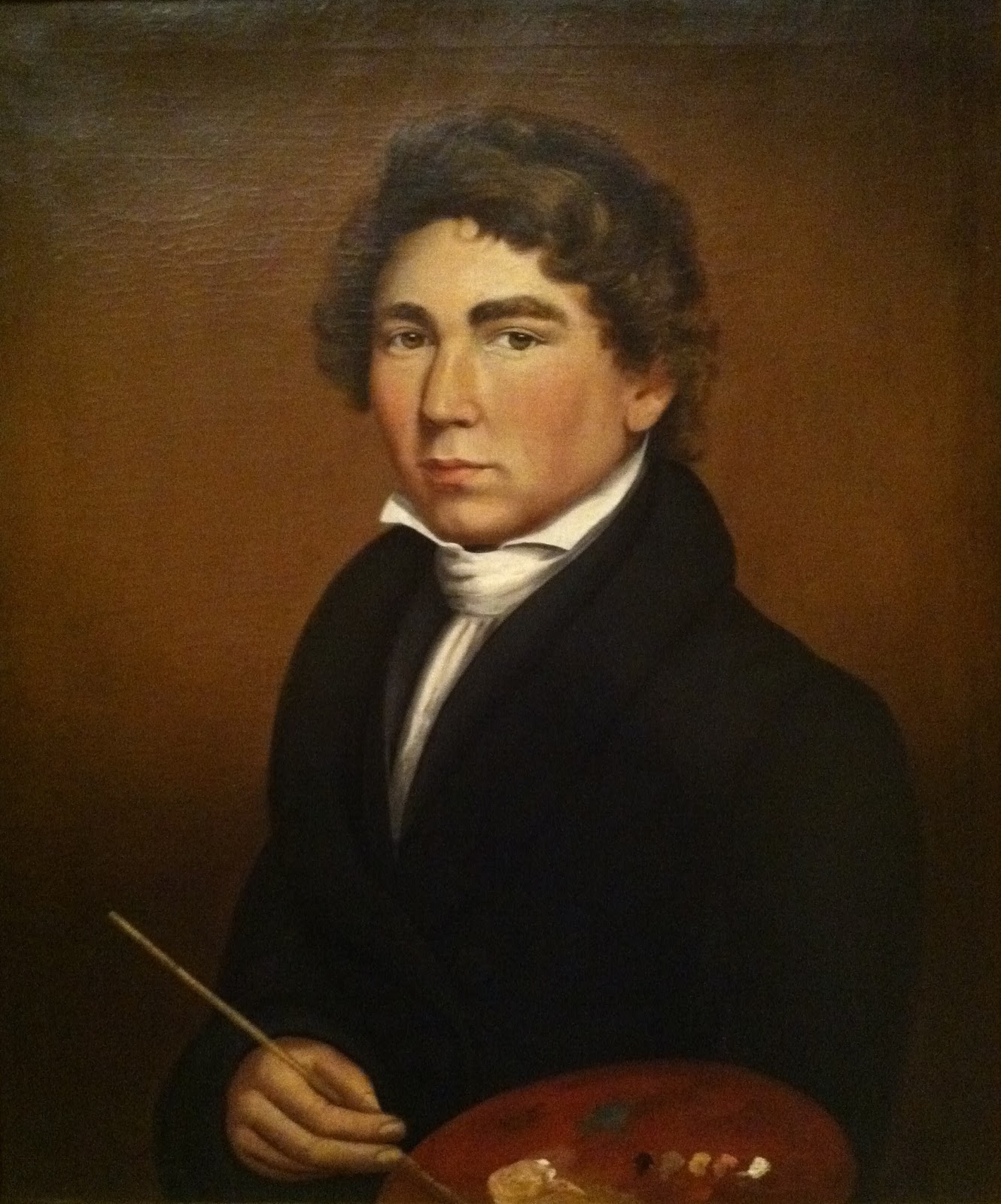
We recently had our great self-portrait by William Matthew Prior conserved in preparation for the upcoming exhibition, Artist & Visionary: William Matthew Prior Revealed, which opens May 26 at the Fenimore Art Museum. I must admit that even though I expected it to look better than before, the results far surpassed my expectations. Judge for yourself by comparing the piece after conservation (above) and before (below). The conservators at West Lake Conservators did a fantastic job.


In particular, please note the colors on the artist's palette, now visible in their full richness. It is no accident that Prior tilted the palette outward so we could have this view of the color scheme that enlivened so many likenesses of his in the early 19th century. As our guest curator, Jackie Oak, stated, "For Prior, art was a business." That is why this self-portrait not only shows who he was, but also gives the prospective client a taste of the range of hues at his disposal to use in immortalizing his subjects.

Thursday, March 15, 2012

Got Wheat?


One large, central, sheaf of wheat. This image welcomed patrons to Lansings’ Inn, an establishment in Lansingburgh, New York, in the opening years of the nineteenth century. Located on the Hudson River about 12 miles north of Albany, Lansingburgh was a busy place at the turn of the century. Today incorporated into the city of Troy, Lansingburgh then boasted its own academy, shipyards, newspaper, and upwards of 10 taverns! With so much competition and bustle in Lansingburgh, why did the owner of Lansing’s Inn choose a wheat sheaf, of all things, to grace the all-important sign?


There are a few different reasons why this could be the case. The unknown owner and the anonymous maker of the sign obviously thought carefully about what image they wanted to depict. Wheat was an important commodity in the area during the early nineteenth century. Local farmers would bring their wheat into town, where it would be sold and shipped on the Hudson River. Troy’s city seal also evidences the economic importance of wheat-it is a sheaf of wheat surrounded by boxes and barrels with a tall merchant ship in the background. The wheat market played a significant role in the region’s development and success.


Since wheat was so important to the area economy, it would have been a recognizable image to people in town. It could have meant a variety of different things to them, from a literal reading as an agricultural crop or a trade good to a symbol of national prosperity or a desire for a good harvest. It also reflected well on Lansing’s Inn, announcing the establishment as a prosperous place, with plenty of good food and drink.  Paradoxically, the sheaf of wheat was both a very local but also a very universal symbol.

As an advertisement, the sign would have appealed to many different audiences, welcoming all to the inn. Locals or travelers, farmers or merchants, one large, central sheaf of wheat spoke to them all.

Got Wheat?

by Ashley Jahrling, American Folk Art course, Cooperstown Graduate Program
Blog Widget by LinkWithin