Showing posts with label William Matthew Prior. Show all posts

Friday, February 15, 2013

"Fascinating!!!" -- The New York Times


I just received word that a terrific review of our William Matthew Prior exhibition appeared in today's New York Times. You can find it here. It is a remarkable insightful review that recognizes the complexities of calling people "folk artists" in a time well before the term was ever used. Prior's case is one of the most interesting and complex, and the reviewer notes that his work, "were it to appear in an exhibition of paintings by Manet and his followers, would not be out of place."

Wow. I love that. Another reminder to forget the categories and look at the art. Enjoy the review, and please see the exhibition if you can. It will be at the American Folk Art Museum until May 26.

Sunday, August 12, 2012

Wandering Thugs of Art


There are a lot of great period quotes that give us a good idea of how nineteenth-century writers regarded the works of folk artists. Most, if not all, of the quotes are disparaging to the point of hilarity. This particular example is noteworthy for its source, Oliver Wendell Holmes, Sr., the physician and writer who wrote prose and poetry alongside Ralph Waldo Emerson, Henry Wadsworth Longfellow, and the other Fireside Poets, and published many of his works in The Atlantic Monthly, a magazine that he helped to found. His son and namesake, of course, became a famous Supreme Court Justice in the early twentieth century and wrote such iconic majority decisions as his "clear and present danger" opinion in 1919's Schenck v. United States.

But it is the opinions of the elder Holmes that concern us today, and it appears that he felt the works of folk portraitists were a clear and present danger to American society. Here is what he had to say about these traveling artists in The Atlantic Monthly in July of 1861:

"[these are the] wandering Thugs of Art whose murderous doings with the brush used frequently to involve whole families; who passed from one country tavern to another, eating and painting their way - feeding a week upon the landlord, another week upon the landlady, and two or three days apiece upon the children, as the walls of those hospitable edifices too frequently testify even to the present day."

This was so good we had to use it in our catalogue for the William Matthew Prior exhibition. But as someone who has spent a good part of his life studying and exhibiting this artwork, I can only be grateful that this is one majority opinion that has been dramatically overturned in our time.

Friday, May 11, 2012

Portrait of a Future Wife


The William Matthew Prior portraits are coming in and we are laying them out in the gallery. This is one of my favorite parts of the job, seeing artwork come together and shaping multiple pieces into a coherent exhibition. The exhibition is shaping up nicely, but the most fascinating thing has been the inscriptions on the reverse of many of the canvases. I thought I would share a few of those with you.

Here is Prior's portrait of his future wife, Rosamond. He met her when he went from his hometown of Bath, Maine, to Portland to seek training in the painting trade. After arriving in town, he went to the best known house painter in the area, Avery Hamblin. As luck would have it, Avery had a daughter. Here she is. Prior painted her in 1824 and married her in 1828.


The inscription reads: "W. M. Prior, Painter, formerly of Bath, 1824, 3 piece on cloth, painted in C. Codman's shop, Portland, Maine." Codman was a marine painter that Prior trained with in his early years.

In making such a detailed inscription Prior was documenting himself in preparation for an artistic career. What we may never know is what personal thoughts he may have had in mind while painting Rosamond. He may have been showing off a bit for her by adding so much detail. It does seem that he made the right first stop when arriving in Portland, and certainly had a flair for impressing his patrons.

Wednesday, March 28, 2012

William Matthew Prior Revealed


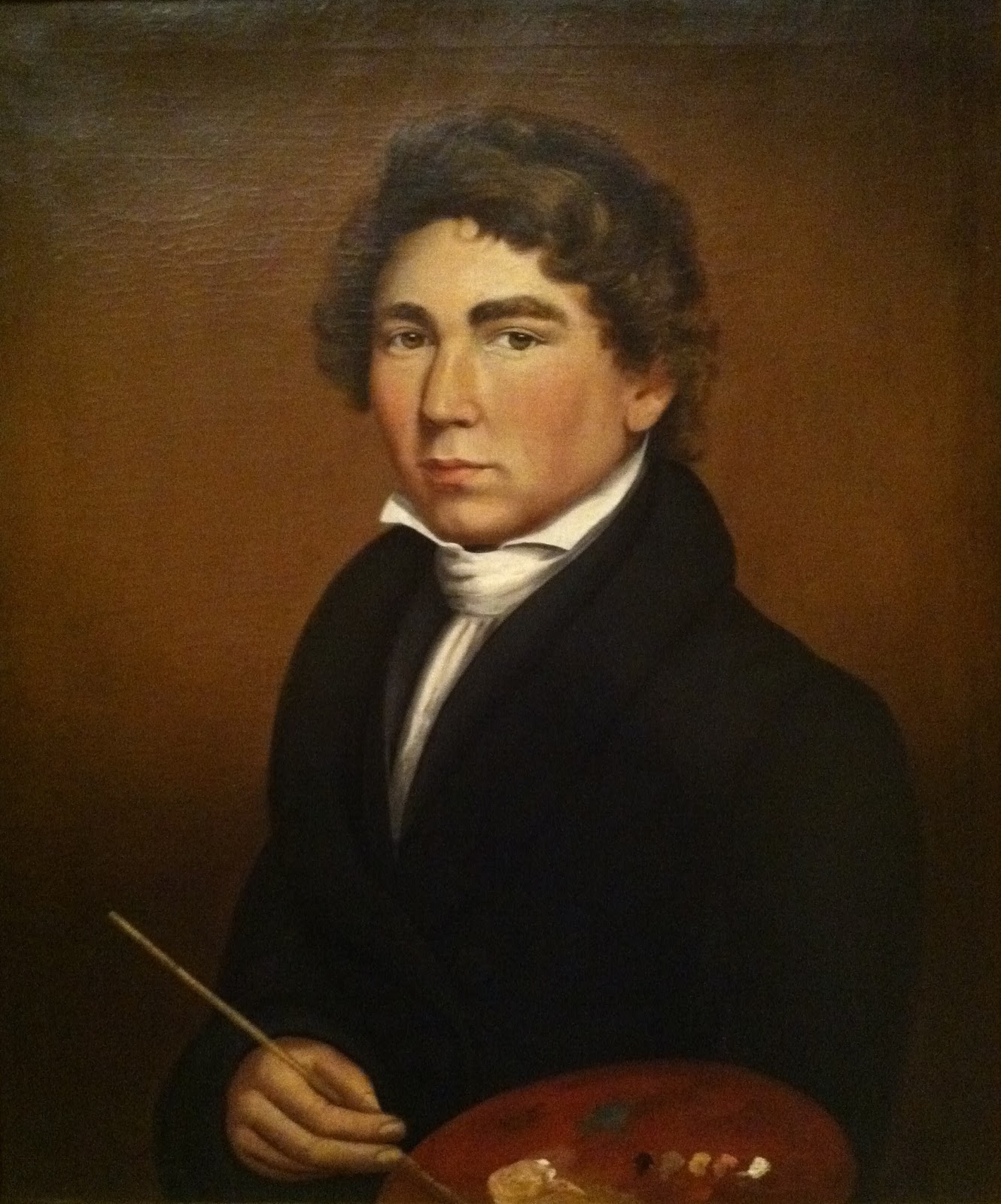
We recently had our great self-portrait by William Matthew Prior conserved in preparation for the upcoming exhibition, Artist & Visionary: William Matthew Prior Revealed, which opens May 26 at the Fenimore Art Museum. I must admit that even though I expected it to look better than before, the results far surpassed my expectations. Judge for yourself by comparing the piece after conservation (above) and before (below). The conservators at West Lake Conservators did a fantastic job.


In particular, please note the colors on the artist's palette, now visible in their full richness. It is no accident that Prior tilted the palette outward so we could have this view of the color scheme that enlivened so many likenesses of his in the early 19th century. As our guest curator, Jackie Oak, stated, "For Prior, art was a business." That is why this self-portrait not only shows who he was, but also gives the prospective client a taste of the range of hues at his disposal to use in immortalizing his subjects.

Monday, May 10, 2010

Portrait of the Artist as a Young Man


The self taught artists who traveled the back roads of early America painted likenesses of all manner of people, but rarely did they depict themselves. I know of only a few self-portraits by American folk artists, and they are all fascinating documents of the appearance and demeanor of the artists. Owing to a successful bid at the recent Leigh Keno auction on May 2, we now have in the Fenimore Art Museum collection one of the best known self portraits still in private hands; that of William Matthew Prior (1806-1873).

Of the many folk portrait painters represented in the Fenimore Art Museum collection, William Matthew Prior is one of the most accomplished and interesting. He began his artistic career in Maine in the 1820s and settled in Boston in the 1830s with an extended group of colleagues and family members. Under his leadership, this group revolutionized folk portraiture. Prior was the first folk artist to institute a price scale, offering to paint likenesses “without shade or shadow” at one-quarter the cost. This innovation made his portraits widely available to the middle class, and allowed him to compete with more accomplished academic painters in the Boston area.


Prior was also an important figure historically, as he became involved in a variety of reform movements. He was an avid abolitionist, and painted more portraits of African Americans than any other artist of his time. Prior was a follower of the religious leader William Miller, and painted several Millerite banners explaining visually the visionary’s unique reading of Biblical prophecy. His wife, it should be noted, advertised herself as a “clairvoyant” and Prior himself claimed to be able to paint portraits of sitters long dead by “spirit effect.”

The Fenimore Art Museum’s American folk art collection includes eight works by Prior that represent his range of interests and styles. We have portraits from the high and low end of his price scale, a portrait of a prominent African American, a portrait thought to be of William Miller himself, and a pair of landscapes. The signed self-portrait represented a rare opportunity to acquire the capstone of this sub-collection.


The painting is signed twice, and dated 1825. It is fascinating to see how accomplished Prior was this early in his career (he was just 19 years old). Prior’s folkier pictures actually come later, when he was trying to appeal to a broad middle class. Our retrospective on Prior, slated for 2012, is going to explore the very blurry line between folk art and academic art in the early 19th century, and the intersection of folk art and the myriad reform and religious movements of the era.

William Matthew Prior stands at the center of this study. And now we have his likeness, painted as only his brush could.

Saturday, November 7, 2009

New Project, and You Heard it Here First!


My good friend Jackie Oak came to town this week to give a lecture about the Shelburne Museum and Electra Havemeyer Webb to the graduate students in my American folk art course. Jackie has been a great folk art scholar for decades; she curated the landmark exhibition “Face To Face: Milton Hopkins and Noah North” for the Museum of Our National Heritage in Lexington, Massachusetts back in the 80s. It was a rich cultural history of folk art, reform movements, and westward migration.

Well, it seems Ms. Oak has a new idea for a folk art project, only this time she’s going to do it for the Fenimore Art Museum in 2012. It’s an idea that has needed to be done since the 1940s. That’s why I’m so excited.

Her subject will be one of the most interesting and influential folk artists of the 19th century. And one of the strangest. The exhibition and catalogue will be about William Matthew Prior.
Here are some facts about Prior to whet your appetite and let you know why this is going to be so exciting.

Prior (1806-1873) was born in Maine and learned to paint there, then moved to Boston where he and his in-laws and friends formed a large painting studio where they all worked in a similar style. It has taken scholars years to sort out who did what.

Prior was an ardent abolitionist, and did more portraits of African Americans than anyone else, and at a time when it was not always safe to do so. His portraits of black subjects include William Whipper from our collection at the upper right, Mrs. Lawson from the Shelburne Museum at the upper left, and Three Sisters of the Copeland Famiy above.
Prior was also one of the great folk painters of children, and often captured their likenesses in vibrant colors and lively compositions, such as the patriotic image of the Flye children at the left.

Prior was a follower of the religious leader William Miller; many of the portraits he painted were done with the artist’s firm belief that the world was going to end in 1844. The Fenimore Art Museum owns Prior’s portrait of Miller!

Prior was the first (and maybe the only) artist to develop a price scale and offer simpler portraits for ¼ price, thus making likenesses accessible to the working class.

Prior advertised that he could paint portraits “by spirit effect” and capture likenesses of people long dead, like ship captains lost at sea. His wife advertised as a clairvoyant.

There’s a lot more to the story, of course. And Jackie is the perfect cultural historian to bring it all out. But I wanted all of you to hear it here first. Stay tuned.
Blog Widget by LinkWithin