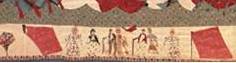
This fall we will have about two dozen quilts displayed in "Unfolding Stories," a show that explains their cultural context in a variety of ways. Our guest curator for this show is quilt scholar Jacqueline Atkins, who curated our Tokyo exhibition. Take a good look at these installation shots, and if you can make it to Cooperstown before the end of the year, come see them in person.
Showing posts with label Quilts. Show all posts
Friday, September 16, 2011
A Story Unfolds
This fall we will have about two dozen quilts displayed in "Unfolding Stories," a show that explains their cultural context in a variety of ways. Our guest curator for this show is quilt scholar Jacqueline Atkins, who curated our Tokyo exhibition. Take a good look at these installation shots, and if you can make it to Cooperstown before the end of the year, come see them in person.
Saturday, March 19, 2011
Encountering God at the MFA
Recognition of Powers' work came very early. In 1886, a young artist of Athens, Georgia, Jennie Smith, went to the Athens Cotton Fair. There she saw Powers' other great quilt, the Bible Quilt (now in the National Museum of American History, Smithsonian Institution, below). She wrote: "I have spent my whole life in the South, and am perfectly familiar with thirty patterns of quilts, but I had never seen an original design, and never a living creature portrayed in patchwork, until the year 1886....in one corner there hung a quilt which 'captured my eye' and after much difficulty I found the owner, a negro woman, who lives in the country on a little farm whereon she and husband make a respectable living....The scenes on the quilt were Biblical and I was fascinated. I offered to buy it but it was not for sale at any price."
Harriet later sold the quilt to Ms. Smith, and hard times compelled the latter to only offer five dollars. Harriet and her husband, facing financial trouble themselves, readily accepted the money. But before leaving Ms. Smith's she explained all of the panels in the quilt.
In recent years another great quilter, Kyra Hicks, has done extensive research on this extraordinary artist who was born a slave in 1837 and became a landowner after the Civil War. Kyra's book, "This I Accomplish," broke new ground in the study of Powers and her work. The most startling find for many was that Harriet was actually a literate woman and a quilter of some local renown prior to her "discovery." Other surprises await in Ms. Hicks' volume, but I would rather have her tell you what they are.
For now, you can view another national treasure of textile art at the MFA. As you look at the fifteen squares, each a different story (mostly Biblical), pay particular attention to the brilliance of Powers' improvisational style. There is very little like it anywhere, except in her other quilt at the Smithsonian.
And look closely at the blue square in the center. It depicts the Leonid Meteor Shower that took place in 1833, a few years before Powers was born. The stories told by the slaves of this phenomenon must have left a deep impression on the young Harriet. By placing this image at the heart of her quilt, I think Harriet was connecting the spiritual with the physical. Her lively and profound affirmation of the presence of God on Earth is now on view in a spectacular new venue every bit the equal of the Athens Cotton Fair.
Labels:
African Americans,
Boston MFA,
Harriet Powers,
Quilts
Friday, August 20, 2010
River of Life
The piece is considered one of the greatest American quilts of all time, and one of the very few that feature a pictorial narrative akin to the genre paintings of the era. It is our Trade and Commerce quilt by Hannah Stockton Stiles, a 105” x 89” bedcovering made of cotton and chintz in about 1835. Hannah was born in Trenton, New Jersey and married John Stiles of Philadelphia in 1818. The two cities flank the Delaware River, a bustling commercial waterway that in the 1830s was loaded with all manner of ships, wharves, dockworkers, taverns, and shops taking advantage of the immense maritime traffic.
Her centerpiece for the quilt is highly symbolic, an immense Tree of Life. She borrowed this image and tradition from the imported palampores of India, but the notion of a life-giving river that provided everything for the people along its banks is central to the artist’s intent.
Monday, February 8, 2010
Black Barbie Comes to Cooperstown
The marketing staff at Keepsake Ornaments, a division of Hallmark Cards, was in brainstorming mode. They wanted to attract more Black costumers, and were floating ideas about different collectible Christmas ornaments that would appeal to a black clientele. The big idea that was being tossed around, an African American Barbie doll ornament, did not sit well with Marketing Strategist Kyra Hicks. Black Santa Claus, maybe. Christmas angels with different skin tones, maybe. But Black Barbie?Kyra Hicks was more than a marketer. She was and is an acclaimed quilter. Following the meeting, she channeled her emotions into the creation of a remarkable quilt. This quilt was one of the major pieces featured in the Fenimore Art Museum’s exhibition “Through the Eyes of Others: African Americans and Identity in American Art.” At the close of the exhibition, we just couldn’t bring ourselves to send it back to the artist. So we bought it.
Hicks uses the medium of fabric in traditional, yet innovative ways to create pieces layered with rich narratives which reinterpret ideologies of popular culture. Hicks represents an American popular icon in her quilt Black Barbie (1996). The quilt features a black version of the original Barbie (1959). The use of text in this piece plays an integral role in communicating messages to the viewer. “Barbie” is scripted in its signature style across the top of the quilt, with “American’s Doll” written underneath. The choice to script “Barbie” in the traditional style enables viewers to instantly connect with the piece as their cultural memory is stimulated.
The bottom of the quilt, however, changes everything. It reads “Was never intended for me.”
Though the artist wrote these words from an African American woman’s perspective, this phrase has the ability to apply to many different women. The legacy of Barbie has impacted women of all shapes, sizes, and colors who feel they do not fit into society’s ideal framework. Painted behind the bottom text are five repeating lines of “Black Barbie has no name” This portion of the piece is not visible from across a room and encourages the viewer to further analyze the quilt. Hicks considers this one of her nuances, explaining that she creates multiple layers of messaging.Black Barbie is a powerful piece which addresses issues of body image and society’s obsession with beauty. Standards of “beauty” are dictated in the media and in popular culture, whether they are based on race or class, on a local, national or international level. Hicks’ reinterpretation of the traditional Barbie offers and different view of beauty.
The quilt presents a story that transcends race and class boundaries, and has the ability to unite women of multiple backgrounds. Hicks explains that she tries to work through whatever she is feeling in a way that is universal. The reinterpretation of a popular iconic fictional woman enabled Hicks to present her personal emotions in a universal form.
Black Barbie will be on view in our folk art galleries beginning on April 1st, making its debut as part of our permanent collection. I have no doubt that it will have an iconic presence in the museum for many, many years. You won’t, however, be seeing it as a Christmas card any time soon.This post was co-written by Cara Bramson of the Cooperstown Graduate Program as part of my elective course in American folk Art. To find more of Kyra Hicks’ work, as well as her thoughts on quilting, see her blog, Black Threads.
Subscribe to:
Posts (Atom)