Showing posts with label Cemeteries. Show all posts

Wednesday, September 1, 2010

Tribute to a Ship Captain's Wife


Imagine a relief carving in stone that was every bit as detailed and every bit as good as a watercolor of the same subject. That’s what I encountered by chance in a rural cemetery on Martha’s Vineyard last week. The cemetery is tucked away along a narrow two-lane road just north of West Tisbury, in the center of the island. We stopped there – ignoring the “are you kidding?” complaints from our teenaged daughter – hoping to find some good old fashioned New England winged death heads. We found those aplenty, but the real surprise was this pictorial scene of a mourner at an urn, more detailed and figural than any I have seen previously.


In fact, it reminded me immediately of our watercolor mourning pictures of the same era. The stone carving was done for a ship captain’s wife, Polly Mantor, who died in 1817. In addition to the lettering the border treatments, and the weeping willow, the carver set aside an arched vignette near the top of the gravestone for the mourning picture. It shows a classically garbed mourner, who at first appears to be weeping, standing beside (indeed leaning on) a large urn with the inscription “O! Death.”
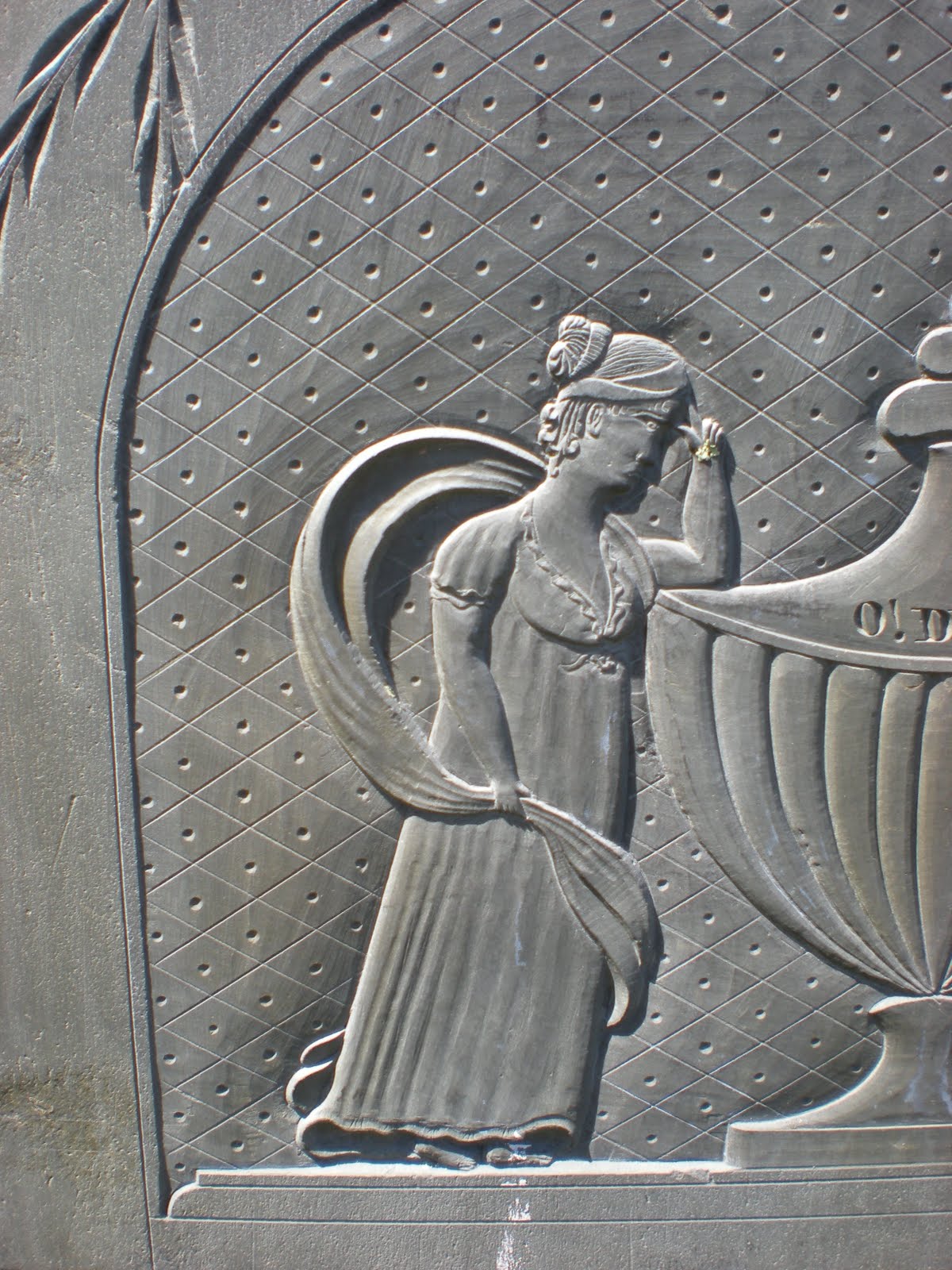

There are astonishing details here for the medium: the flowing shawl or scarf that curls its way around the mourner; the rendering of her hair and facial features; and the pattern of the background, which resembles a period wallpaper. Looking closely, I also noticed that her left hand is not holding her forehead in the conventional weeping pose, but rather is pointing upward in a gesture seen as a disembodied hand on many of these stones with the saying “Just Beyond.”


I compared this carving to two of watercolors done about the same time, circa 1810-1820, by Eunice Pinney of Connecticut. The first of these, her memorial to herself (that’s another story!) shows the mourning scene iconography that gained popularity in the United States after the death of George Washington in 1799. The second, entitled simply “Two Women,” is not a mourning picture at all, but show the same pattern seen in the background of the carving, only here as a floor covering.


Polly Mantor died at the young age of 31 in 1817. Her husband, Captain Jeremiah Mantor, obviously paid well for this elaborate stone. He outlived her by 44 years, and died in 1861 at the age of 84. In a culture surrounded by death, it appears that the visual means of coping with loss were many and varied, and folk artists were there with both brush and chisel to provide tangible expressions of an all-too-common grief.

Saturday, August 28, 2010

Mutiny and Murder in the Edgartown Cemetery


My annual family trip to Martha’s Vineyard is a great time to reconnect with the great seafaring traditions that are far less evident in landlocked Cooperstown, New York. The Vineyard was a major whaling center in the early decades of the nineteenth century, when whale oil was a precious commodity and captains could get very wealthy from a single successful voyage. The best whaling was in the Pacific Ocean, so these voyages were quite long and arduous; there was no Panama Canal, so the ships had to go around Cape Horn at the southern tip of South America to reach the prime whaling waters.

Edgartown, on the eastern end of the Vineyard, was the island’s prime whaling port, and thus it is the place where the history of whaling is most in evidence. And nowhere is it more prevalent than the Westside Cemetery right in the heart of town, where many of the ship captains are buried and commemorated in stone.

These gravestones hold a particular fascination for me, of course, as exceptional examples of American folk art. They were created by craft-trained stone carvers who over time developed their own distinctive styles. A comparison of two weeping willow vignettes on two Edgartown gravestones illustrates this point. One of the trees is quite realistic in its rendition, while the other is very stylized and nearly abstract.

Of all the gravestones in Edgartown, there is one that I have to pay my respects to every time I come here. From a distance you would hardly notice it. It carries no elaborate decoration and is a fairly standard shape. As you get closer you realize that there is a lot of writing, but it is only when you begin to read that you become riveted to the spot. Here is how it starts:
“Capt. Archibald Mellen, Jr., born at Tisbury June 5, 1830, and murdered on board ship Junior of New Bedford off the coast of New Zealand Dec 25, 1857: by Cyrus W. Plummer.”
Wow. Sure beats the sappy romantic pieties of the usual gravestone inscription. Think about it: not only does his tombstone give the gory details of the captain’s demise, it also names his murderer! An indictment in stone.

The story of the murder is well known, and one of the more famous mutinies involving Vineyarders. According to the histories of the voyage, Captain Mellen was on a whaling voyage near New Zealand when, on Christmas Eve 1857, he gave his men each a cup of grog and retired for the evening. Plummer and several conspirators later stormed the cabin and killed Mellen and his third mate while wounding several other officers. The murderers threw the dead officers overboard. (I suppose this is why Mellen’s gravestone doesn’t begin with “Here lies....”)
They were later captured in Sydney, Australia, and put on trial back in the United States. They were defended by Benjamin Butler, the Civil War general, who claimed the actions were the result of ill treatment of the sailors on the part of Captain Mellen. Butler successfully reduced Plummer’s charge from mutiny to “deliberate murder.” Plummer was sentenced to hang, but his sentence was commuted to life in prison by the President, James Buchanan. And there Plummer died, years later. (The other conspirators served out jail terms and were eventually released).

Back in Edgartown, the Mellen family had none of it. They must have commissioned the stone, and used their money (and the carver’s talents) to condemn Plummer for eternity. The gravestone inscription concludes: “Thus, at an early age, at the flood tide of successful manhood, an intelligent, honest, and worthy man became the innocent victim of the insatiable ambition of these conspirators.” Case closed.
Blog Widget by LinkWithin